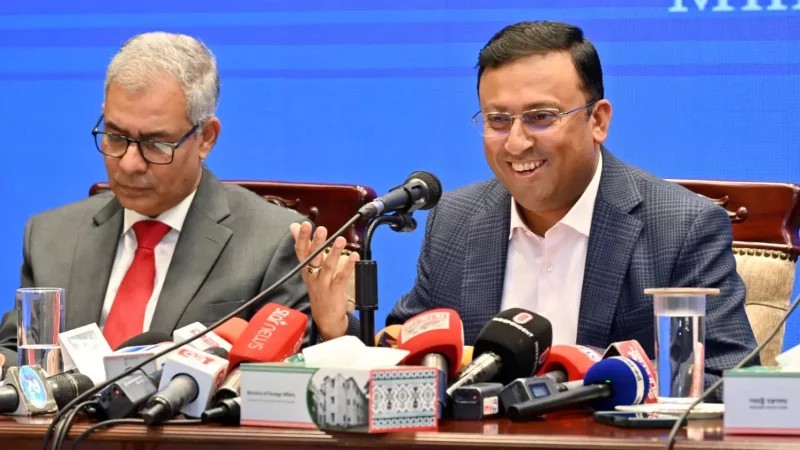
State Minister for Foreign Affairs Humaiun Kobir stated on Friday that no reference to any third country arose during the Prime Minister’s recently concluded official visit to Japan. He emphasized that the visit focused exclusively on an economic partnership between the two nations.
"We made it very clear... no third country reference. We didn't go there to discuss the Bay of Bengal because the Bay of Bengal doesn't belong to us only," he told reporters at the Ministry of Foreign Affairs, highlighting the achievements of the visit.
Salahuddin Noman Chowdhury, who is set to become the next Foreign Secretary, and Additional Foreign Secretary (Public Diplomacy and Other Priority Matters) AKM Shahidul Karim were also present at the media briefing.
The state minister stated that Bangladesh is building a respectful bilateral economic partnership with Japan, describing it as an investment-driven partnership.
In light of the rapidly changing global situation, increasing supply chain risks, rapid technological innovation and mounting social issues, Bangladesh and Japan agreed to upgrade BIG-B to “BIG-B for Shared Prosperity” as an initiative of “strategic cooperation” under the exclusive partnership between the two countries.
Responding to a question, Kobir stated that there was no scope for the government to go against the interests of the country and its people.
Regarding the Rohingya issue, the state minister stated that it was an important national security issue and that Bangladesh continued to raise it, emphasizing that the solution to the problem lies in Myanmar.
On Tuesday, the prime ministers of Bangladesh and Japan convened for a summit in Tokyo, which was followed by a joint press event and a luncheon.
The two leaders issued a “Japan-Bangladesh Joint Statement” after the summit meeting.
The Japanese prime minister congratulated Prime Minister Tarique Rahman on assuming office, describing him as a friend who shares the values of democracy.
She said that amid growing global instability, Japan strongly supports Bangladesh’s ability to make its own decisions and its resilience under the updated "Free and Open Indo-Pacific (FOIP)" and intends to further develop bilateral relations under the "Strategic Partnership".
She also expressed her intention to work with Prime Minister Tarique Rahman towards peace and prosperity in the region.
In response, Prime Minister Rahman stated that Japan had followed the path of a peace-loving nation and was among the first countries to recognise Bangladesh’s independence.
He said Japan holds a special place in the hearts of the people of Bangladesh.
Rahman also stated that Japan and Bangladesh had cultivated long-standing amicable relations and expressed his commitment to working together with Prime Minister Takaichi to elevate bilateral relations to new heights.
The two leaders agreed to upgrade the "Bay of Bengal Industrial Growth Belt (BIG-B)" concept into a new strategic cooperation initiative called "BIG-B for Shared Prosperity." This framework is built upon four pillars: strengthening connectivity; enhancing preparedness for natural disasters and geopolitical risks; utilizing public-private partnerships to co-create economic growth opportunities and rule-making; and fostering cooperation for peace and stability.
The parties also agreed to cooperate in developing the Bay of Bengal region, with Bangladesh as its hub, into a “region of shared prosperity.”
Prime Minister Takaichi said that private investment by Japanese companies in Bangladesh is projected to reach ¥1 trillion over the next five years, generating an estimated 200,000 jobs, and that she intends to send a business mission to Bangladesh in the near future.
In response, Tarique Rahman said he welcomed and highly valued investment from Japanese businesses.
The two leaders agreed that their governments would work to ensure the early entry into force of the Japan-Bangladesh Economic Partnership Agreement (EPA) and promote cooperation in areas such as trade and investment, agricultural, forestry and fishery products, the environment and climate change, as well as aviation.
Prime Minister Takaichi expressed her expectation that Prime Minister Rahman would provide leadership in creating an environment conducive to Japanese business activities and promoting public-private cooperation.
Prime Minister Rahman responded that the Government of Bangladesh would also work towards this goal in a transparent manner.
Prime Minister Takaichi announced that Japan will provide a patrol vessel to Bangladesh to enhance the country’s maritime security capabilities under the Security‑Contributing ODA programme.
The two leaders reaffirmed their commitment to continuing security and defence cooperation and working together to maintain peace and security in the region.
Prime Minister Rahman expressed his deep gratitude for the cooperation extended by the Government and people of Japan to Bangladesh to date. He further stated his intention to work towards “shared prosperity” for the two countries.
Reflecting on the cooperation between the two countries, which has expanded across a wide range of fields, including security, the economy and people-to-people exchanges, he expressed his intention to continue strengthening cooperation with Japan in various areas.
Why it matters
The visit reaffirms the strengthening of bilateral economic and strategic ties between Bangladesh and Japan through major investment commitments and upgraded cooperation.