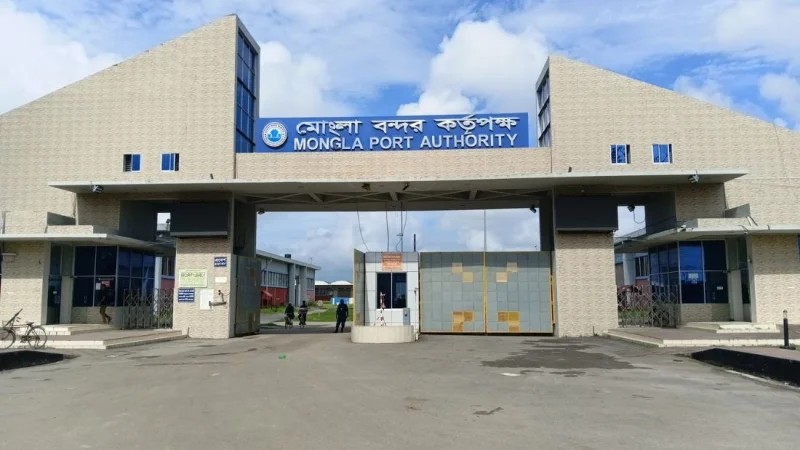
The Padma Bridge has unexpectedly transformed the export dynamics of Mongla Port. Frozen food shipments through the port have nearly halved from pre-bridge levels, even as improved connectivity with Dhaka has opened an entirely new export stream in garments.
Frozen food exports through Mongla dropped significantly from 33,316 metric tons in the 2020-21 fiscal year to 17,262 tons in the 2024-25 fiscal year, marking a decline of approximately 48 percent. Exporters increasingly shifted their operations to Chittagong Port in order to secure vessels capable of meeting the strict schedules demanded by overseas buyers.
Simultaneously, garments have emerged as a significant new cargo for the southwestern port of Mongla, having had virtually no export presence there before the Padma Bridge opened on June 25, 2022.
Garment exports started at 454 tons in the 2022-23 fiscal year before increasing more than tenfold to 4,730 tons in the subsequent year. An additional 4,181 tons were exported during the 2024-25 fiscal year.
The differing trends underscore the way the bridge has reshaped the competitive relationship between the nation’s two major seaports.
Faster road connectivity has made Mongla considerably more accessible to Dhaka-based exporters. At the same time, it has also made it easier for southwestern businesses to move time-sensitive goods to Chattogram when appropriate vessels are unavailable at Mongla.
Frozen food had traditionally been one of Mongla’s important export commodities.
In FY2020-21, 33,316 tons were exported through the port in 3,081 TEUs. The following year, shipments stood at 31,715 tons.
Following the opening of the Padma Bridge, exports dropped to 22,575 tons in FY2022-23 and remained almost unchanged at 22,576 tons the following year, before falling to 17,262 tons in FY2024-25.
SK Kamrul Alam, vice-president of the Bangladesh Frozen Foods Exporters Association in Khulna, attributed the shift largely to vessel schedules.
Frozen food exporters must comply with strict deadlines set by international buyers, he said. Because ships matching those schedules are not always available at Mongla, exporters are forced to send their consignments through Chittagong.
“When a ship is available at Mongla Port that matches the schedule, we use Mongla,” he said.
Mongla Port Authority Chairman Rear Admiral Arif Ahmed Mostafa acknowledged the challenge.
He stated that Dhaka could now be reached from Mongla in approximately four hours following the opening of the Padma Bridge, compared with around seven and a half hours between Dhaka and Chittagong.
That has helped attract garment exporters to Mongla, but the same connectivity allows frozen food traders to reach Chittagong when vessel schedules make it necessary.
The shifting cargo mix comes as substantial parts of Mongla’s existing capacity remain unused.
The port has an annual capacity to handle 1,500 vessels, but it accommodated 815 ships during the last fiscal year, operating at 54.33 percent of its total capacity.
Cargo throughput performed considerably better, reaching 12.251 million tons against a capacity of 15 million tons, representing 81.67 percent.
Container utilisation remains much lower. Mongla handled 29,714 TEUs against an annual capacity of 100,000 TEUs, which is just 29.71%.
It also handled 12,075 reconditioned vehicles against capacity for 20,000, representing 60.37%.
Despite those challenges, the port exceeded its FY2025-26 revenue target by collecting Tk387.95 crore against a target of Tk367.87 crore. This represented an increase of Tk40.83 crore, or 11.76%, compared to the previous year.
Port authorities are currently seeking to increase vessel calls, with a particular focus on container services, while simultaneously developing Mongla as a direct “first calling port.”
Plans include attracting direct feeder services to major hubs such as Singapore, improving the Khulna-Mongla and Khulna-Bhanga road links, and addressing navigability along the port's 144-kilometre channel.
Two container terminals, a container handling yard and a delivery yard are planned under the Indian LoC-3-funded Upgradation of Mongla Port project.
The port is also procuring two tugboats, a buoy-laying vessel, a search-and-rescue vessel, a pilot mother vessel and a survey-and-research vessel under another project scheduled for completion in June 2027.
Mostafa said the projects were aimed at increasing Mongla’s capacity and accelerating trade and economic activity across the southwestern region.
Why it matters
Infrastructure enhancements and connectivity shifts are actively reshaping trade patterns and port utilisation across regional economic hubs in Bangladesh.