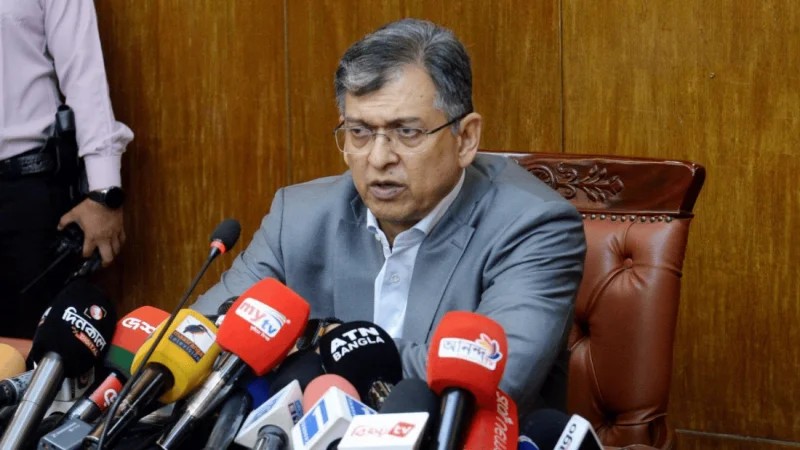
Home Minister Salahuddin Ahmed has announced plans to expand the operations of the Cyber Police Unit across the country. The expansion will cover central, divisional, district, and upazila levels in order to prevent and combat digital crime.
He said that expediting the delivery of justice requires various forms of analysis, evidence obtained through testing, and proper certification. As the nature of crime evolves, plans are also underway to enhance the capabilities of law enforcement agencies to meet emerging challenges.
He made the remarks on Wednesday while inaugurating the newly constructed Cyber Police Center building and the digital forensic laboratory of the Criminal Investigation Department (CID) in Chittagong.
Ambassador of the Republic of Korea to Bangladesh Kim Ji-jun, Sayed Al Noman, MP, Inspector General of Police (IGP) Md. Ali Hossain Fakir, Additional IGP (Headquarters) Sardar Nurul Amin and Additional IGP (CID) Barrister Mohammad Mosharraf Hossain were present at the ceremony, alongside senior administrative officials including Chittagong Divisional Commissioner Dr Mohammad Ziauddin, CMP Commissioner Hasan Mohammad Shawkat Ali and District Superintendent of Police Masud Alam.
Noting that the nature of crime has changed in the modern world, the Home Minister said many crimes are now committed in cyberspace, ranging from various forms of fraud to financial crimes such as stock market manipulation.
“There is no alternative to a digital forensic laboratory for preventing and combating these crimes,” he said.
He stated that plans for a police cyber unit had been in place from the outset and that its operations officially began on October 1. The unit currently operates under an Additional Inspector General, while the newly inaugurated digital forensic laboratory will function under the supervision of the CID. Relevant departments will continue to cooperate in digital forensic analysis and testing, as they all fall under the same ministry.
Under the leadership of the Cyber Police Unit, authorities will take steps to strengthen digital analysis capabilities at every level, from the central administration down to divisions, districts, and upazilas, the Home Minister stated.
He added that plans were also underway to establish Cyber Police Unit laboratories at the district and divisional levels to operate as digital forensic laboratories.
He noted that the CID had been operating chemical laboratories since its inception and issuing reports on various tests, including visceral analyses. “With changing times, expanding the capacity and scope of these laboratories has become essential,” he said.
Salahuddin Ahmed stated that the Government of the Republic of Korea and the Korea International Cooperation Agency (KOICA) provided full support for the construction of the newly inaugurated building and the digital forensic laboratory in Chittagong. He expressed his gratitude to the Korean government, the Korean ambassador, KOICA representatives, and the visiting Korean delegation for their assistance.
"Law enforcement agencies will be equipped with the necessary capabilities to prevent and combat crime in the modern digital world," he stated. "To this end, all necessary preparations will be made, including laboratory facilities, essential equipment and other support resources, Insha'Allah."
CID sources stated that the department has implemented measures to enhance the police force's investigative and technical capabilities for fighting cybercrime in key areas of the country, including Chittagong, as part of a project titled “Safer Cyberspace for Digital Bangladesh.”
As online banking, mobile financial services, e-commerce, and digital payment systems continue to expand, financial fraud, illicit transactions, and attempts to conceal the origins of funds are also on the rise.
Why it matters
The expansion aims to strengthen Bangladesh's capacity to combat rising digital crime and improve justice delivery.