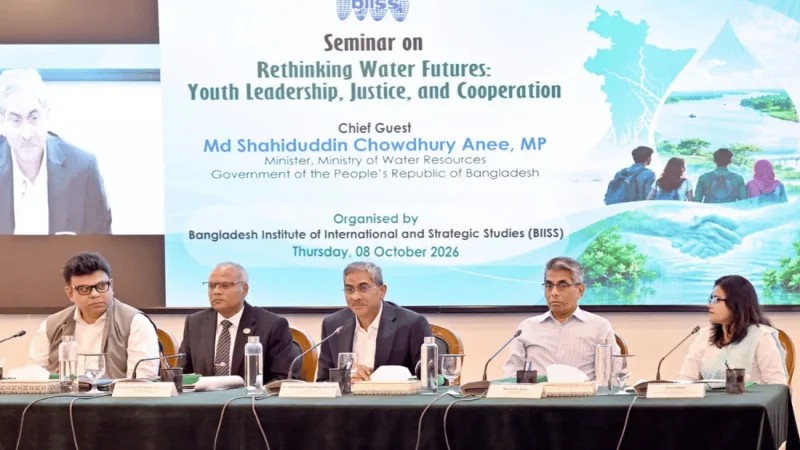
Water Resources Minister Shahiduddin Chowdhury Anee expressed hope on Thursday that a new Ganges water sharing treaty with India would be signed before December 12 of this year.
Restoring the guarantee clause, as included in the 1977 agreement, is one of Bangladesh's top priorities for the new treaty, Anee stated to reporters. This remark was made following a seminar entitled "Rethinking the Future of Water: Youth Leadership, Justice and Cooperation," which was organized by the Bangladesh Institute of International and Strategic Studies (BIISS).
The minister stated that the existing 30-year agreement is set to expire on December 12. "A five-year agreement signed in 1977 during the tenure of then president Ziaur Rahman contained a guarantee clause but the provision was dropped when the new treaty was signed in 1996," the minister added.
"We must conclude a new Ganges water treaty before December 12," Anee said, adding that Bangladesh and India are working regularly through the Joint Rivers Commission (JRC).
Based on meetings between the two countries, Bangladesh is optimistic that the new treaty will be finalized ahead of the deadline, according to the minister.
The minister also stated that work on the Padma Barrage would become visible between January and March of next year.
He added that the government is also moving forward with a plan to complete the feasibility study for the Teesta multipurpose project and to commence main construction in 2027.
Describing the Padma Barrage and the Teesta Master Plan as mega projects of great importance, Anee stated that approximately one-third of the country's population would benefit once these initiatives are implemented.
The Padma Barrage project has already received approval from the Executive Committee of the National Economic Council (ECNEC), he added.
"We hope the work will become visible sometime in January, February or March next year," he said.
On the Teesta Master Plan, the minister said it was another major challenge for the government.
"The Teesta is a swift-flowing river, and people in the downstream areas have long been suffering because of water coming from upstream," he said, stressing the need for technical support from local and foreign experts.
He said discussions have been held with experts from the Bangladesh University of Engineering and Technology (BUET), who have been given responsibility in this regard, while many other local and international experts have also been consulted.
"The feasibility study of the Teesta project will begin very soon, and main work will start based on that study," he said, expressing hope that the necessary work, including the feasibility study, would be completed in 2027 and the main work launched in the same year.
When asked whether any foreign pressure or obstacles existed regarding the Padma Barrage and Teesta projects, the minister stated that the people living along the Padma and the Teesta are citizens of Bangladesh.
"The interests and expectations of the people of the country are the biggest concern for me," he said, adding that the government's main goal was to work for their welfare.
Speaking about the progress of the Padma Barrage, he said the project's feasibility study took a long time, lasting from 2004 to 2016, and was not implemented afterwards.
"The present government finalized the matter and started work within a few months of taking office," he said.
Noting that a study for a project as large as the Teesta cannot be completed overnight or in a month or two, the minister stated that previous authorities failed to seek adequate technical support to finish the job.
"The present government wants to complete the necessary work on its own initiative and give the Teesta project a visible shape," he added.
Why it matters
Securing a new water-sharing treaty ensures Bangladesh's rightful access to the Ganges River, vital for agriculture, domestic supply, and industrial needs, thereby strengthening national resilience and diplomatic ties with neighboring India.