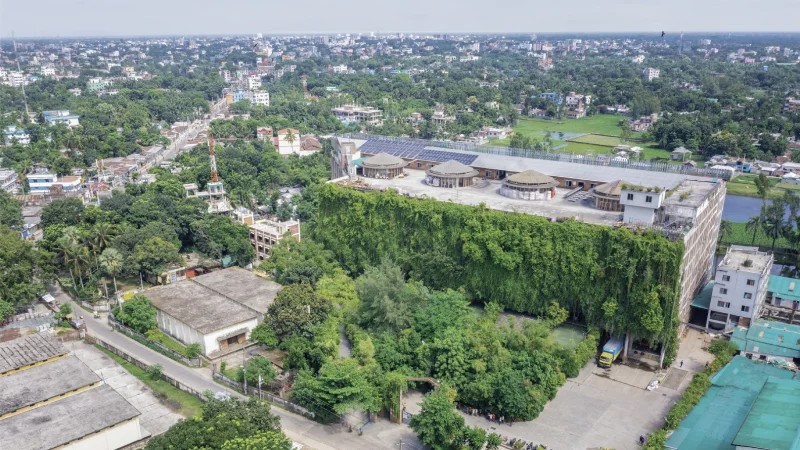
The Royal Institute of British Architects (RIBA) has awarded its prestigious International Prize to Karupannya’s Green Field factory, located in Rangpur.
Designed by the soft-spoken and unassuming architect Bayezid Khondker and his practice, Nakhsabid Architects, this achievement represents another architectural honor for the country. This is also not the first time a building from Bangladesh has won the award.
Friendship Hospital in Satkhira, designed by architect Kashef Chowdhury, won the prize in 2021.
Since the prize’s inception in 2015, there have been five winners, two of them from Bangladesh.
The Karupannya factory was chosen from four shortlisted projects, including two from Bangladesh. The other Bangladeshi project was the BRAC University campus in Dhaka, which was designed by the Singapore-based architectural practice WOHA.
The shortlist was drawn from 34 projects recognised in the RIBA International Awards for Excellence 2026.
Louis Kahn lecturing at BUET in the 1960’s. Photo: Collected
The list also featured a second project from Bangladesh: the Zebun Nessa Mosque, which was designed by architect Saiqa Iqbal Meghna of the firm Morphogenesis.
Bangladeshi architects have won numerous notable international awards for their work.
These include the prestigious Aga Khan Award for Architecture.
Kashef Chowdhury and Marina Tabassum won the award separately in 2016, followed by Saiful Haque in 2019. They were subsequently followed by Khondaker Hasibul Kabir and Suhailey Farzana, Rizvi Hassan, Khwaja Fathmi and Saad Ben Mostafa in 2022.
Marina Tabassum won again in 2025, setting a record by becoming a two-time recipient of the award.
Other Bangladeshi projects that have previously received this award include the Grameen Bank Housing Project and the Bangladesh National Parliament building, which was designed by Louis I Kahn.
Bangladesh holds the second-highest number of projects to have received this award, following Iran. Another recipient was Bangladeshi structural engineer FR Khan, recognized for his design of the Hajj Terminal at Jeddah Airport.
Bangladeshi architects have also received countless international awards and recognitions over the years.
These include awards from the Commonwealth Association of Architects (CAA), the JK Cement Awards, the International Union of Architects (UIA), and ARCASIA, among others. Listing all the awards and their recipients would leave little room to discuss the actual subject of this article.
Comparing the relative size of its professional community—including approximately 5,000 registered architects in Bangladesh, compared with around 150,000 in India, 6,000 in Pakistan, 130,000 in the United States, and 28,000 in the United Kingdom—it can be confidently stated that Bangladesh, as a small country, has performed better than its neighbors, which include India, Pakistan, Sri Lanka, Thailand, and Malaysia.
It is difficult to pinpoint any single reason or even compile a definitive list of explanations for this phenomenon. Questions remain as to whether the underlying cause is genetic, the result of training and education, or driven by passion, making it hard to determine if there is something unique possessed that others do not.
Examining the background that has produced good architects in Bangladesh might suggest several possible explanations. However, there is no empirical evidence, data, or research to support these explanations, which are simply observations about the country's architectural culture.
The country and the region feature Muzharul Islam, a pioneering modern architect, alongside examples of his world-class architectural projects constructed from shortly after Partition through to the 1980s. He also set an example not only through outstanding buildings, but through high ethical standards and devotion to the profession, in addition to his eloquent, sophisticated and articulate personality.
Bangladeshi architects, almost without exception, recognize him as a "guru" and look to his high standards as an example to follow. His creations, including the Charukala Institute, the Dhaka University Library, the NIPA building, and the two universities, continue to serve as landmarks and sources of inspiration. For students, visiting some of his buildings is almost like a pilgrimage.
Then there is the National Parliament building complex, designed by Louis I Kahn. The Parliament building itself is recognised as one of the hundred most influential buildings of the last century.
Muzharul Islam was instrumental in bringing the internationally recognized master architect Kahn to the country. Believing the nation should possess an exemplary work by a renowned architect of the era—just as India had Le Corbusier—Islam convinced the government to engage Kahn, offering this as his gift to the younger generation of architects. Architects and students continue to study this remarkable example and draw inspiration from it.
In the 1960s, several internationally renowned architects worked in the region: Paul Rudolph designed buildings at Mymensingh Agricultural University; Constantin Doxiadis designed the Teacher‑Student Centre (TSC) at Dhaka University, Home Economics College and BARD complex in Cumilla among others; and Muzharul Islam and Stanley Tigerman jointly designed five polytechnic institutes.
There were others, such as Robert Bouighey, Richard Vrooman and Daniel Dunham, who were less widely known but designed buildings that inspired our architects. These included Kamalapur Railway Station, halls of residence at BUET and Dhaka University, the Faculty of Architecture and Planning at BUET, and buildings at Rajshahi University, among others. These buildings are excellent examples of tropical modernism and provide valuable lessons for architects.
Friendship Hospital, Satkhira. Photo: Courtesy of Kashef Chowdhury
The Department of Architecture at the Bangladesh University of Engineering and Technology (BUET), then known as the East Pakistan University of Engineering and Technology, introduced an undergraduate program in architecture in 1962.
The institution was initially established by a group of American teachers from Texas A&M University, including Richard Vrooman, who served as the first dean and designed the faculty building. The building remains in use and is cherished by students and alumni. Other teachers included Daniel Dunham and Walden, among others.
They taught a small group of students for several years until Bangladeshi teachers who had been sent abroad returned to take over around 1967–68.
From the very beginning, the department fostered a culture in which architecture was treated with the utmost seriousness as a profession.
There was an almost sacred devotion to the subject, something approaching a religious conviction, and both students and teachers were deeply committed.
The building itself nurtured the culture, featuring spacious corridors, large studios and an open ground floor supported by columns, now known as the “plinth.” It evolved into a venue for serious discussions and arguments.
I have not encountered this kind of passion in any other school, although I have taught at several institutions abroad and visited many others.
Let me cite a small incident that exemplifies this almost religious devotion.
A younger colleague, who was also a former student, and I were teaching architectural graphics to freshmen. My colleague was explaining how to set up their drawing sheets on the table.
He said, “First, go and wash your hands carefully with soap and dry them.”
When the students had done so and returned to class, he explained how the drawing sheet had to be aligned with the parallel bar and fixed to the table with tape, and how pencils needed to be sharpened—preferably by hand with a blade rather than a sharpener, then further sharpened using grade 0 sandpaper and dipped into Styrofoam to remove graphite granules.
Once that was done, he said, “Now go and wash your hands again.”
When they returned, he told them, “Now approach your work as if you are performing ‘ebadad’, meaning prayer.”
The entire ritual of washing one’s hands twice before approaching the task had to be followed, with the same devotion as prayer. Such was the culture.
The carefully designed admission process ensured that only students with a genuine interest in architecture were admitted.
There was a separate admission test for architecture, with 80% of the questions assessing creative and drawing skills and the remaining 20% covering mathematics. The mathematics questions were exceptionally difficult, going beyond what students had learned at the HSC level, and candidates did not have to pass that section separately to qualify.
I believe this was quite deliberate, ensuring that students could not gain admission solely on the strength of their mathematical knowledge.
The result was that students who genuinely wanted to study architecture and possessed drawing and artistic skills were admitted, although the competition was intense. The studios appeared to have a more artistic than technical orientation.
Unfortunately, that admission system was discontinued in 1999, and there is now a common admission test for the whole of BUET. Eight architecture faculty members resigned in protest and left.
The architecture department was housed within a technical university where engineering programmes predominated. While architecture programmes at technically oriented universities worldwide typically lean toward a technical focus, the programme at BUET was artistic in orientation.
Moreover, the faculty building occupied its own separate space, away from engineering.
Students and faculty members from other disciplines often regarded architecture as a less serious subject than their own. Architecture was ridiculed, and there were taunts about architecture students doing little more than drawing trees and similar things.
The subject was even referred to as “yarki-tecture”, with yarki being the Bangla word for joke or banter.
This no longer happens. Bangladeshi architects have proved themselves and have received more international accolades than members of any other profession in the country.
Such was the devotion to and seriousness about architecture.
Meanwhile, the country’s economy began to grow, creating opportunities for architects to showcase their work. Architecture has become a popular profession, and there are now more than 30 architecture programs across the country.
There may be other reasons why Bangladesh produces such good architects, but I cannot say with certainty what they are.
Today, apart from the architects who have already won awards, there is an emerging generation of talented young architects producing excellent work.
The author is the Dean of the School of Architecture and Design at Brac University and the founder of its architecture program. He is a graduate of BUET and has also taught there.
Why it matters
This international recognition highlights Bangladesh's growing prominence and excellence in global architectural design and innovation.