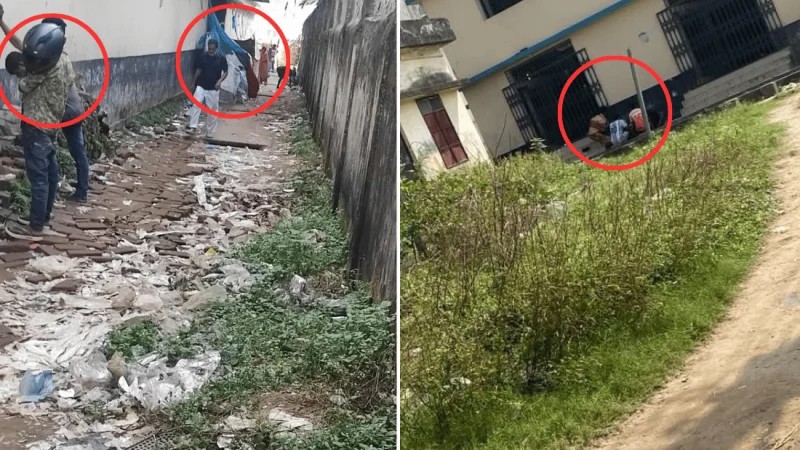
Barely 20 metres from a mosque and 50 metres from a ferry crossing in Tongi, hundreds of people gather in broad daylight to buy, sell and consume narcotics.
Makeshift drug dens operate openly, surveillance cameras monitor visitors, and armed groups allegedly control access to parts of the neighbourhood.
In Haji Mazar Basti, a sprawling settlement on the banks of the Turag River in Gazipur, repeated police raids, eviction drives, and the destruction of drug dens have failed to dismantle an entrenched narcotics network.
An infographic details the conditions within Haji Mazar Basti, highlighting its dense population, open drug trade, makeshift shelters, surveillance measures, and the challenges facing law enforcement.
The extent of the alleged criminal control is such that even police officers acknowledge the dangers of entering the area.
“Even we, the police, are afraid to go there. It’s as if it’s a separate state within Bangladesh,” an anonymous police official told the Dhaka Tribune.
The officer said law enforcement personnel had previously encountered violent resistance while gathering intelligence and conducting operations.
“Even when we go in a group, we are unable to accomplish anything,” a source stated. “I once went there with a colleague to gather intelligence and barely managed to make it back out.”
An investigation published by the Dhaka Tribune on November 6 revealed that narcotics were being openly sold and consumed throughout the settlement. Furthermore, residents alleged that the criminal network continued to operate under the influence of politically connected individuals.
The investigation itself turned violent when three Dhaka Tribune journalists were attacked by suspected drug traders, taken to a secluded location, and beaten by a group of approximately 20 to 25 people.
Spread across approximately five acres near Abdullahpur, Haji Mazar Basti is home to an estimated 30,000 people.
The settlement is accessible through two roads from Tongi and from the Turag River.
At its centre stands the shrine and mosque of Hazrat Syed Shah Bogdadi (RA), which is surrounded by densely packed tin-roofed houses and multistorey structures.
Residents alleged that the narcotics business was previously controlled by individuals affiliated with the Awami League, but that influence shifted toward local BNP leaders and members of its affiliated organizations following the political change on August 5, 2024.
During the visit, at least five offices bearing the signboards of the BNP and its affiliated organisations were observed at different entrances to the settlement.
Most were closed, while two were open but unattended.
Residents claimed that many of these offices previously displayed Awami League signboards, which were replaced following the July uprising.
Billboards featuring local BNP leaders and prospective ward councillor candidates were also visible.
However, the presence of political offices and billboards does not independently establish that their occupants control or benefit from the drug trade. The allegations of political patronage remain unverified.
During the investigation, reporters witnessed suspected narcotics transactions and drug consumption at several locations.
Residents said cannabis, yaba, phensedyl, pethidine, charas, opium and locally produced and foreign liquor were readily available.
They also alleged that illegal firearms were traded in the area.
At Jhilik Tea Store, a grocery and tea shop situated in a narrow alley, five young men were observed consuming what appeared to be yaba and cannabis.
When the journalists approached, eight women standing outside the shop ushered the men indoors and asked the reporters to leave.
Residents alleged that several influential women, commonly addressed as “bhabis” by buyers and sellers, played important roles in the narcotics network.
Their identities and specific involvement could not be independently established.
The most striking scenes emerged near the Ijtema ground, where dozens of makeshift shelters had been erected behind toilet buildings numbered 26 and 27.
At least 30 to 40 cloth shelters were visible, which were reportedly rented out to drug users at various rates.
Around noon, approximately 200 people gathered in front of and behind the buildings, where suspected drug sales and consumption took place openly.
Some individuals invited journalists to consume narcotics, while members of a local youth group instructed visitors to remove their masks before entering certain shelters.
A mosque stood approximately 20 metres away, while a ferry crossing was about 50 metres from the site.
A government office of the Department of Inspection for Factories and Establishments was also situated within the settlement, where drug activity was reported nearby.
The suspected narcotics network appeared to operate its own surveillance arrangements.
CCTV cameras monitored entrances, while unfamiliar visitors were reportedly questioned and required to obtain permission by telephone before entering certain sections.
Residents said newcomers sometimes had their belongings inspected.
Tongi West Police Station Officer-in-Charge Md Arifur Rahman acknowledged that police had previously attempted to dismantle the surveillance network.
“We recently conducted an operation in the area, destroyed all the CCTV cameras installed by them, demolished their drug dens and disconnected electricity connections,” he said.
However, surveillance arrangements were reportedly restored after the operation.
The apparent ability to rebuild such infrastructure raises questions about the lasting effectiveness of enforcement measures.
Police and other authorities have conducted several operations in Haji Mazar Basti, but suspected drug trading has repeatedly resurfaced.
On July 22, police disconnected electricity and internet connections to rooms belonging to around 300 identified suspected drug traders.
After the operation, Gazipur Metropolitan Police Additional Commissioner Mohammad Belayet Hossain said the extent of open drug use in the settlement was an exceptional and longstanding concern.
In August, Rajuk demolished around 100 illegal structures and suspected drug dens on approximately three bighas of land.
Another eviction drive was conducted on August 31 near the Department of Inspection for Factories and Establishments office.
Police raids between May and subsequent months reportedly uncovered more than 100 rooms and hidden tunnels allegedly used for drug trading and escape.
Some facilities reportedly contained air-conditioned rooms where influential individuals allegedly gathered to consume narcotics.
Yet residents say the operations have failed to permanently dismantle the network.
Residents identified several other locations in Tongi where narcotics were allegedly sold, including Bank Math Basti, Keranir Tek, Amtali Basti, Millgate Basti, Ershadnagar, Shilmun, Morkun, Arichpur, Gazipura, Khortail Madina Para, Pagaar and Gopalpur.
They alleged that disputes over narcotics distribution and mugging had triggered violent confrontations and killings.
On September 28, Rafiqul Islam Joy was killed in Bank Math Basti, while Nurul Islam was allegedly killed in Gopalpur on September 1 following a dispute involving yaba, according to local sources.
The settlement has also drawn scrutiny after the death of former Air Force officer KM Tahsif Sauri, whose body was recovered from the Turag River following his reported visit to the area.
The circumstances of his death and any connection to the alleged narcotics network have not been established.
Gazipur Metropolitan Police Commissioner Md Ashiq Sayeed, who newly appointed and joined the office on Sunday, told Dhaka Tribune that the police would adopt a zero-tolerance policy against drugs.
“I have joined Gazipur Metropolitan Police today. We will maintain a zero-tolerance policy towards drugs. We will take all necessary measures, including arresting drug dealers and criminals and conducting operations to eliminate crime, to make the entire Gazipur, including Tongi Mazar Basti, free from drugs and terrorism.
“Our specialised police units are fully prepared to carry out such operations, and we will take all necessary steps. We will also launch a strong crackdown on drug dealers in Tongi Mazar Basti very soon,” he said.
OC Arifur Rahman said suspected drug traders had adapted their operations following earlier eviction drives, establishing mobile distribution points around the Turag River and Ijtema ground.
He said suspects frequently escaped towards areas under Dhaka Metropolitan Police jurisdiction or dispersed through the Ijtema grounds when police attempted raids.
Discussions had taken place with senior officers about conducting larger operations, he added.
For residents of Haji Mazar Basti, however, the repeated return of suspected drug traders after enforcement operations remains a pressing concern.
Why it matters
The persistence of entrenched criminal networks and open narcotics trade despite repeated high-profile police interventions highlights ongoing security challenges in urban industrial hubs.