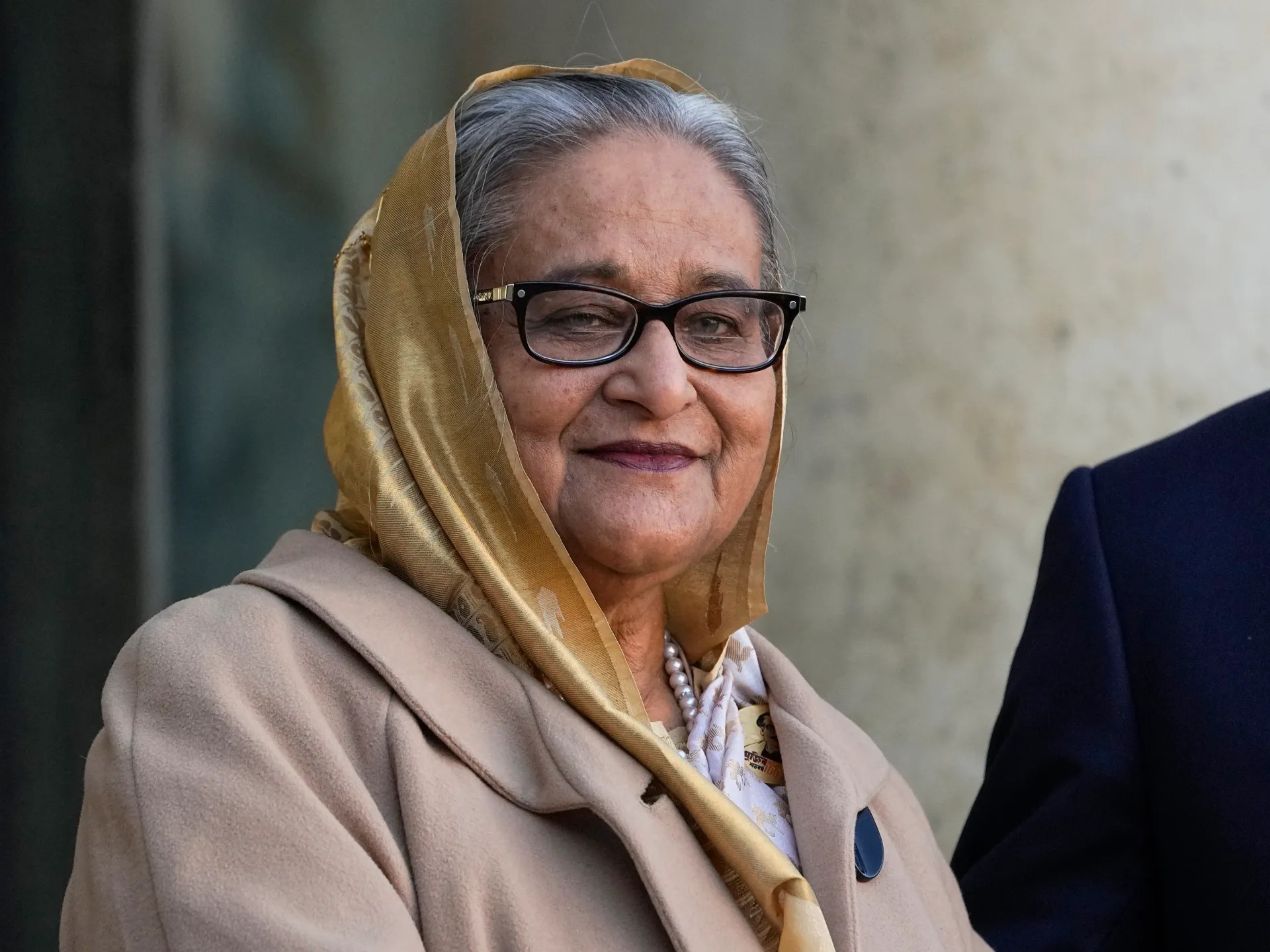
Dhaka, Bangladesh — Sheikh Hasina, the ousted former prime minister, has applied for a new passport so she can return to Bangladesh next month, more than two years after she fled to India following a mass uprising that removed her from power.
The 79‑year‑old former prime minister was sentenced to death in absentia last year for crimes against humanity related to the deadly crackdown on the student‑led protests of 2024, a charge she denies.
She could face a death sentence by hanging if she returns, because the government that succeeded her remains a staunch political opponent.
The authorities in Dhaka have already denied the passport application and have urged Hasina to pursue an extradition request from India should she be genuinely intent on returning home.
State Minister for Foreign Affairs Humaiun Kobir told Al Jazeera that Bangladesh does not issue passports to terrorists who have killed thousands of people and then fled, and that the country will operate under the existing extradition framework with India to pursue and secure the handover of the terrorist identified as Hasina.
On Tuesday, Bangladeshi prosecutor Md Aminul Islam, who secured a death sentence for Hasina at the Dhaka‑based International Crimes Tribunal, warned that she will be executed if she returns home.
“Sheikh Hasina has no option but to face the execution of the verdict,” Islam told reporters.
Hasina has approached the Bangladesh High Commission in New Delhi to request a new passport and a national identity card after her existing documents were revoked. Officials are now examining the reasons for her appeal and the specific plan she intends to pursue.
Sheikh Hasina has ruled Bangladesh with an iron fist for nearly 20 years, still enjoying support from a segment of the population, while many others say they would like to see her hanged.
Her return could exacerbate political tensions as Prime Minister Tarique Rahman’s government seeks to restore stability, two years after the 2024 uprising that resulted in more than 1,400 deaths, the United Nations said.
Analysts question whether Hasina truly intends to return to Bangladesh to face the law, or is merely using the promise to revive her political fortunes while remaining in self‑imposed exile in India.
Zillur Rahman, president of the Centre for Governance Studies—a Dhaka‑based think tank—said that Prime Minister Sheikh Hasina’s passport request appears less an indication of an imminent return than a strategy to keep herself politically relevant as she seeks to retain control of the Awami League party.
He said, “I think she knows what her fate is. But what she wants is to keep Awami League leaders and activists politically engaged,” referring to Prime Minister Sheikh Hasina’s Awami League, a party founded by her father, Sheikh Mujibur Rahman, the leader of Bangladesh’s independence movement.
A source said that, as far as they understand, she refuses to hand over the party’s leadership to anyone under any circumstances, describing this as a major problem for both her and the party. The source added that, had she been willing to step aside, the party might have looked for a way to survive.
Jon F. Danilowicz, a retired United States diplomat who previously served as deputy chief of mission at the U.S. embassy in Dhaka, was more categorical.
He told Al Jazeera that there is no chance Sheikh Hasina will return to Bangladesh in December, adding that, in his view, the claim is a bluff intended to rally her supporters and to reshape the narrative about her growing irrelevance at home.
Faiz Sobhan, senior research director at the Bangladesh Enterprise Institute research centre, also views Hasina’s promise as an effort to boost the morale of her party. The party is currently banned, and many of its leaders are either in jail or in exile.
The announcement keeps Sheikh Hasina politically relevant and lets her gauge the mood at home, he said. An actual return seems inconceivable, since it would mean facing the gallows or spending the rest of her life behind bars, he added.
Despite analysts casting doubt on the prospect of Hasina’s return, her announcement appears to have energised some Awami League leaders and supporters.
“Our leader will return. They have tried to stop her before, but they could not stop her. They are conspiring against her again, but she will overcome these conspiracies and return,” an organising secretary of the party’s central executive committee told Al Jazeera, speaking on condition of anonymity from exile in India.
When asked about how former leader Sheikh Hasina would return and what steps the party was taking to facilitate it, numerous Awami League leaders and supporters stated that they had no clear understanding of her strategy.
"But she has announced that she will return, and I believe she will come back in December, no matter what," Arman Rahman, a Dhaka-based Awami League activist and former leader of its student wing, told Al Jazeera.
Hasina’s future is also tied to India’s calculations.
New Delhi, her close ally for decades, has sheltered her since she fled Dhaka in August 2024. However, her continued presence has emerged as a point of contention between the two nations.
Dhaka has repeatedly sought the extradition of Hasina under a bilateral treaty. New Delhi states it has been examining the requests, with India’s foreign ministry stating in April that it aims to engage constructively with the new government and further strengthen bilateral ties.
Meanwhile, both countries have signalled an interest in repairing strained ties.
Sreeradha Datta, a professor of international affairs at O P Jindal Global University near New Delhi, told Al Jazeera that India views Hasina as a longstanding friend. At the same time, New Delhi is attempting to separate her presence in the country from its broader diplomatic engagement with Dhaka.
"Sheikh Hasina is a very good friend of India. New Delhi looks at her as a friend whom it will always support. That is our official position," she stated.
Former US diplomat Danilowicz believes that New Delhi is increasingly aware of the diplomatic cost of continuing to host Hasina, but is “unlikely to facilitate” her return to Bangladesh.
“While there may be some in India who still believe that Hasina and her party provide them leverage, by now the Narendra Modi government must understand the damage that her continued presence in New Delhi is doing to efforts to normalise relations with Bangladesh,” he said.
“I am certain the Modi government would love to see the Hasina problem go away, including by having her find a third country to reside.”
Rahman, representing the Centre for Governance Studies, provided a distinct explanation regarding why India might continue to shelter Hasina despite the resulting diplomatic complications.
“I think India is finding it difficult to digest her presence, but at the same time, it cannot let her go either,” he said.
“If India does not take responsibility for protecting her now, its other allies in South Asia and elsewhere may lose trust in New Delhi,” warned that they “may feel that India does not ultimately protect those who have stood by it.”
Rahman believes that India may continue to offer refuge to Hasina, but is unlikely to help restore her political domain in Bangladesh.
Speaking about Sheikh Hasina, he said, "I don't think India will abandon her. But at the same time, I don't think it will provide her with all forms of political protection, particularly by helping her return to Bangladesh and reestablish herself here."
Meanwhile, Datta does not expect an imminent improvement in relations between the neighbours. “I don’t think Bangladesh-India relations will return to normalisation very soon,” he said.
Many are also asking whether Hasina could enter into some form of political understanding with the governing Bangladesh Nationalist Party (BNP). The party is now controlled by Prime Minister Rahman, the son of Hasina's longtime rival, Khaleda Zia, who passed away a year ago. Rahman himself lived in exile in London while Hasina was in power.
However, analysts view the prospect of such an agreement as extremely unlikely. Sobhan of the Bangladesh Enterprise Institute characterized the concept as a "non-starter."
An analyst told Al Jazeera that the BNP has little to gain and much to lose from any accommodation with the Awami League. The analyst added that the BNP base spent over 16 years being jailed, harassed and sidelined under Hasina, meaning any hint of a deal would be viewed as a betrayal.
On Monday, Ruhul Kabir Rizvi, the acting secretary general of the BNP and the political adviser to Prime Minister Rahman, also dismissed the prospect of Hasina’s return.
“She is deluding herself if she thinks she can return, reimpose fascism and reclaim her throne,” Rizvi stated at an event in Dhaka.
Sobhan stated that the BNP government had very little room to act outside of the verdict delivered by the International Crimes Tribunal.
“A broader settlement to stabilise the country is hard to imagine, and reconciliation without accountability or an apology is harder still,” he said.
Sobhan added that extradition was the “only formal route” available to Dhaka. “And it means being dragged back [to Bangladesh], not choosing to return,” he stated.
Why it matters
The story highlights the intersection of domestic political crisis, international diplomatic pressure, and the broader regional dynamics between Bangladesh and India, underscoring the importance of extradition and passport policies in shaping national stability.