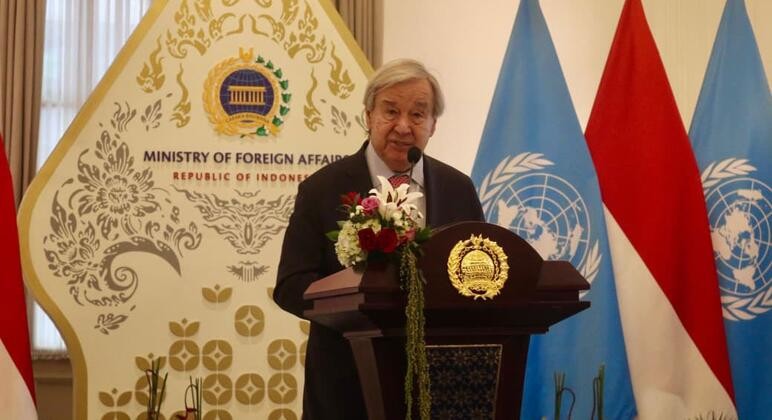
UN Secretary-General António Guterres paid tribute to Indonesian peacekeepers on Monday, laying a wreath in honour of four who recently lost their lives in Lebanon. During the ceremony, Guterres offered a robust defence of UN peacekeeping in what he described as “testing times for peace”.
Speaking to troops at the Indonesia Armed Forces Peacekeeping Centre in Sentul—some of whom are deploying to the Central African Republic (CAR)—Mr. Guterres said the fallen had paid the "ultimate sacrifice" to protect others in very difficult circumstances.
"Their service and their sacrifice will never be forgotten. No one should die serving the cause of peace," he said, extending his deepest condolences to their families.
“Attacks on peacekeepers are grave violations of international humanitarian law and may amount to war crimes. These violations demand accountability,” the UN chief stressed, pledging to keep calling on Member States to ensure the safety and security of UN personnel at all times.
United Nations Secretary-General Mr. Guterres described UN "blue helmets" as "a source of hope in some of the world's most troubled places" and, for him, "a source of enormous pride."
Far from home and in some of the world’s most dangerous settings, the United Nations' 50,000 peacekeepers de-escalate tensions between hostile parties, oversee vital aid delivery, protect civilians, and create space for political solutions to take hold, he said.
Indonesia ranks as the world’s sixth-largest contributor to United Nations peacekeeping, with nearly 2,000 uniformed women and men currently serving across seven missions. Next year, the country will co-host the UN Peacekeeping Ministerial alongside the Netherlands.
Addressing troops preparing to deploy to the Central African Republic (CAR), Mr. Guterres described the nation as "a success story that still needs to be completed." Mr. Guterres has worked with the country for 20 years, initially serving as the UN High Commissioner for Refugees.
Most armed groups have celebrated agreements with the Government and are giving up their arms, he said, adding that the troops’ mission will be decisive in helping State institutions function across the whole territory.
With their success, the UN could then progressively downsize its mission in the country, he added.
Opening his remarks on a lighter note, Mr. Guterres told the troops he was convinced that "no bad guys in [the Central African Republic] will dare confront the Indonesians."
Speaking at the Ministry of Foreign Affairs in Jakarta, Mr. Guterres hailed Indonesia as “a pillar of multilateralism” and a diplomatic bridge-builder between North and South.
With conflicts multiplying, inequality deepening, and trust in institutions declining, he said that many people are questioning whether international cooperation can still deliver.
“The answer to deepening frustration with multilateralism is not less multilateralism. It is better multilateralism,” he said, calling for reform of international financial institutions and the Security Council to reflect today’s world.
Speaking to reporters alongside Foreign Minister Arrmanatha Nasir, UN Secretary‑General António Guterres said that in Gaza, “the nightmare must end.”
"The peace plan must be fully implemented – and we cannot allow the two-State solution to disappear before our eyes," he stated, while paying tribute to Indonesia for consistently remaining at the forefront of support for the Palestinian people.
He expressed concern about Myanmar's worsening crisis and renewed his call for protection of people fleeing violence and persecution, including Rohingya refugees in the region.
Why it matters
The UN Secretary-General's appeal for Rohingya refugees highlights ongoing international attention to the humanitarian impacts of the Myanmar crisis affecting neighboring countries.