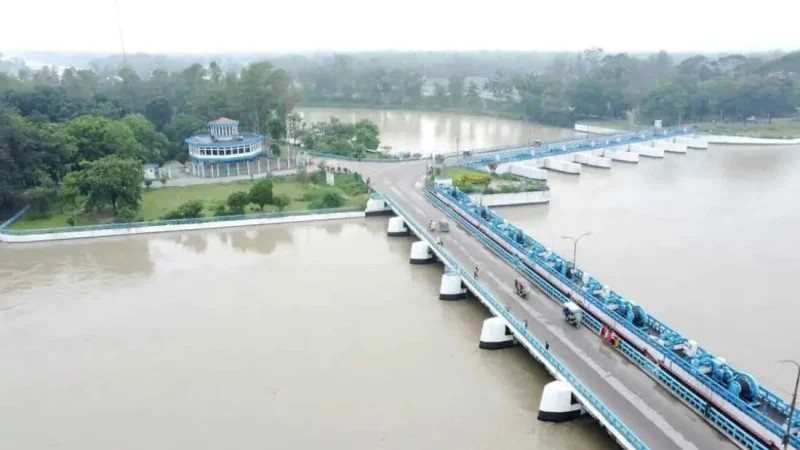
The government has taken a fresh step toward advancing the much-discussed Teesta Master Plan, with the Ministry of Water Resources sending a Tk 23-crore proposal to the Planning Commission for a feasibility study on the project.
If approved, an international consultant will be appointed through a competitive bidding process to evaluate the technical and economic viability of the proposed interventions. These interventions include a new barrage, river training, dredging, flood control, water conservation, and related infrastructure.
Water Resources Secretary Dr AKM Shahabuddin stated that the feasibility study would be crucial for advancing the Teesta Master Plan toward implementation.
"The technical and economic viability of every component will be assessed through the study, and subsequent works for the main project will be taken based on its recommendations," he said.
Planning Division Secretary SM Shakil Akhter stated that the proposal would be examined under the established procedure, taking into account the project's necessity, cost, potential benefits, and feasibility.
If the proposal is approved, it will enable the appointment of a consultant through an international competitive bidding process, he told BSS.
The government has identified finding a permanent solution to the Teesta River’s problems and promoting economic transformation in the northwestern region as priorities. Meanwhile, the BNP's 2026 election manifesto pledged to ensure a fair share of water from the Teesta and other trans-boundary rivers, while stressing balanced regional development and greater use of the agricultural and economic potential of northern Bangladesh.
The proposed master plan envisages a broad package of river and regional development measures rather than focusing solely on a barrage.
The project includes riverbank protection and river training along approximately 110 kilometres, the dredging of another 110 kilometres of the river, and the construction of 224 kilometres of flood-control embankments featuring roads on top.
The plan also proposes the construction or repair of 67 spurs, alongside the reclamation and development of approximately 170 square kilometres of land.
Md Ruhul Amin, director general of the Bangladesh Water Development Board (BWDB), stated that the plan adopts an integrated approach encompassing river-flow management, bank protection, flood control, irrigation, and transport infrastructure.
The feasibility study, he said, would determine the precise locations and scope of the proposed works.
The proposed embankment-cum-road infrastructure could improve connectivity in riverside communities that are frequently cut off during the monsoon. At the same time, the embankments would provide flood protection, potentially combining two important infrastructure functions.
Dredging, however, would require careful consideration of the river’s natural behaviour. River expert Mohammad Ejaz said dredging should take into account sediment transport, water discharge and the river’s flow dynamics.
"Merely deepening the riverbed will not provide a long-term solution," he told the national news agency, adding that the feasibility study should identify appropriate dredging locations and determine how dredged sediment would be managed.
A new barrage is another major component currently under consideration. The government is examining the technical and financial feasibility of constructing another barrage on the Teesta to conserve water during the dry season.
According to Dr Md Ataur Rahman, a professor of Water Resources Engineering at BUET, the feasibility assessment must examine upstream and downstream flows, flood management, irrigation requirements, structural safety, maintenance and environmental considerations alongside water-storage capacity.
The Teesta is closely tied to the lives and economies of people in Rangpur, Lalmonirhat, Nilphamari, Kurigram and Gaibandha. Reduced dry-season flow affects irrigation and agriculture, while high monsoon flows contribute to flooding and river erosion, threatening homes and farmland.
Riverbank protection is another key element of the plan, alongside proposals to strengthen river training and repair or construct spurs. The proposed land reclamation could also open opportunities for agriculture, infrastructure and other forms of local economic development.
Yet the scale of the eventual benefits will depend on the findings of the feasibility study, environmental assessments, final project design, financing, implementation quality and long-term maintenance.
For people in the northern region, the latest move follows years of surveys, plans and expectations surrounding the Teesta.
The proposed feasibility study does not mark the completion of the master plan, but it could move the initiative into a more concrete administrative and technical phase.
Several steps remain before the project can proceed, including completion of the feasibility study and environmental assessment, finalisation of the project design, government approval, financing and field-level implementation.
If implemented, the Teesta Master Plan would extend beyond a conventional barrage or river-management project. It could bring water conservation, irrigation, flood control, erosion prevention, river training, transport, land management and regional economic development under a single integrated framework.
Why it matters
The feasibility proposal initiates critical administrative and technical evaluations needed to address long-standing water management, flood control, and agricultural challenges in northern Bangladesh.