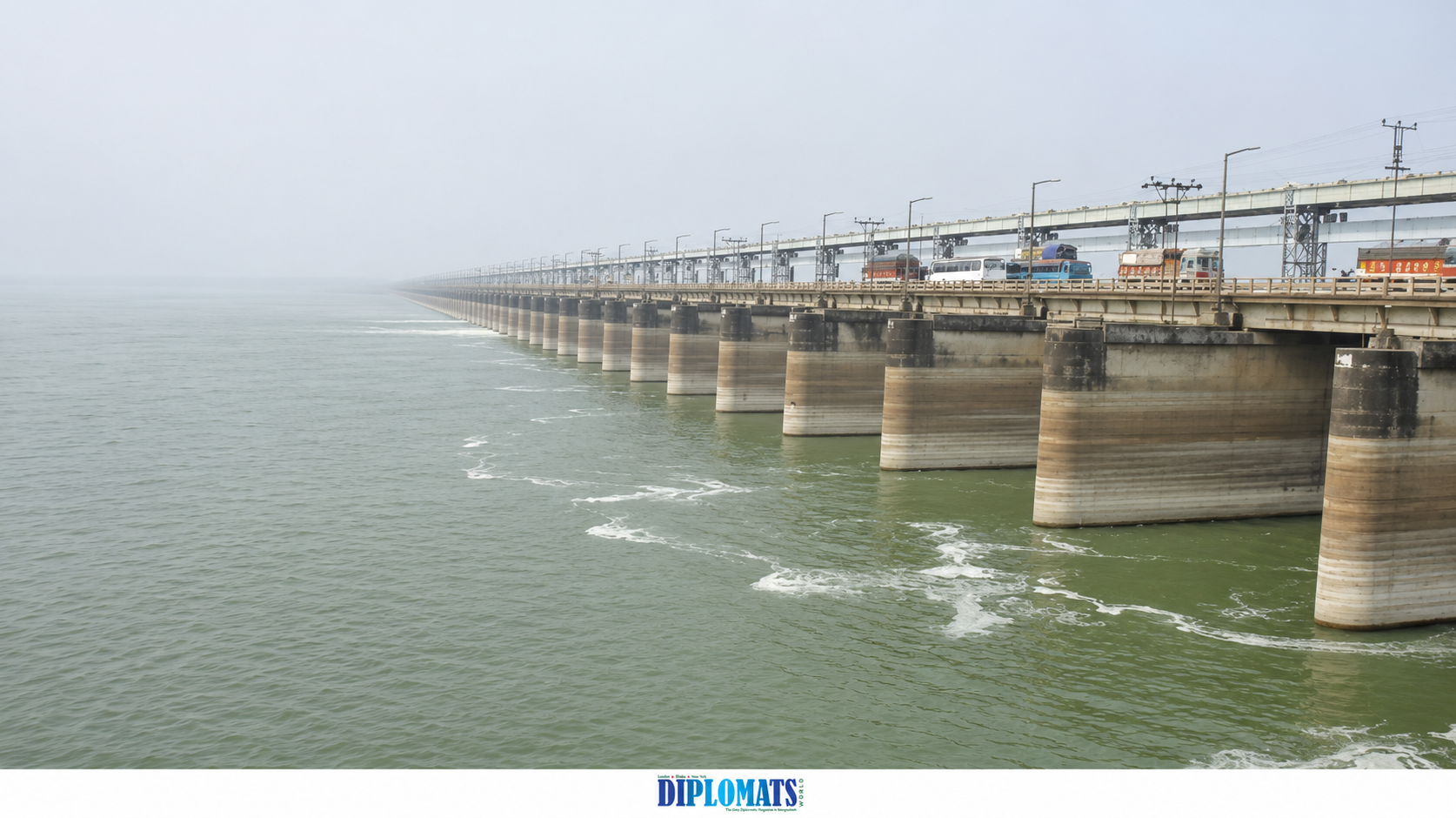
With the 30-year Ganges Water Sharing Treaty between Bangladesh and India set to expire on 12 December, no formal talks have been scheduled regarding a new agreement or its renewal.
Bangladesh is seeking a guarantee clause within a new treaty to ensure it receives its fair share of water. Meanwhile, India has not yet clarified when it will commence formal negotiations on the matter.
The 91st meeting of the Joint Committee of the Joint Rivers Commission (JRC) of Bangladesh and India began in Dhaka today (22 November). The bilateral discussions are scheduled to take place over two days.
It finalised the annual report on implementation of the treaty but did not discuss a new agreement. The meeting was part of the regular monitoring process under the existing treaty.
Md Anwar Kadir, a member of the Bangladesh JRC and chairman of the Joint Committee on the Bangladesh side, led the six-member Bangladeshi delegation at Sunday's meeting. Sharad Chandra, commissioner (FM) and member of the Indian JRC, led the Indian delegation.
"This wasn't a meeting on a new treaty. It was a regular meeting of the Joint Rivers Commission," Kadir told The Business Standard.
Bangladesh wants a treaty that safeguards its interests rather than an extension, with a guarantee clause ensuring a minimum volume of water during the dry season.
On 24 September, Water Resources Minister Shahed Uddin Chowdhury Anee told journalists that Bangladesh wanted a new agreement containing a guarantee clause to protect its share of water. He noted that while the 1977 deal included such a guarantee clause, the subsequent 1996 treaty did not.
"Our main priority will be to bring back the guarantee clause that was included in the 1977 agreement," he said.
Bangladesh proposed holding talks in June and subsequently asked India in August to constitute its delegation, but the country has not yet received a schedule for formal negotiations.
Water Resources Minister Shahed Uddin Chowdhury Anee also wrote to his Indian counterpart on November 17, urging an early start to discussions. India's response is not yet known.
The government has formed a high-level technical committee, led by Prime Minister's Adviser on Finance and Planning Rashed Al Mahmud Titumir, to prepare for the negotiations.
Titumir told UNB that Bangladesh has already completed all necessary preparations related to the treaty. He added that Bangladesh hopes India will take the required steps before the current term expires to pave the way for the commencement of formal negotiations.
In June 2026, Bangladesh formed a high-level technical committee to initiate discussions and informed India of the decision, according to Titumir. Dhaka also requested that New Delhi notify it once it establishes its own technical committee.
Bangladesh renewed its request in August, urging the Indian side to form a technical committee and begin discussions, he added.
India has reportedly begun internal preparations to review the treaty, but the absence of formal talks with Bangladesh remains a major source of uncertainty.
Indian media, citing a report by India's Parliamentary Standing Committee on External Affairs, reported that the Ministry of Jal Shakti formed an inter-ministerial committee in July 2023 to review the treaty. The committee includes representatives from West Bengal and Bihar.
The committee recommended considering updated river-flow data, climate change impacts and the interests of concerned states when determining the treaty's future.
India's deliberations also encompass the water requirements of its own states. Alongside West Bengal, Bihar has raised concerns regarding its allocation of Ganges water.
Any new agreement with Bangladesh will require political and administrative coordination within India, as well as decisions by the central government.
If the treaty expires without a new agreement, Bangladesh's main concern will be water availability during the coming dry season, as the existing sharing formula and guarantees are tied to its 30-year term.
The treaty's expiry does not necessarily mean India will stop releasing water to Bangladesh. The two countries could reach a new treaty, an interim understanding or another diplomatic arrangement. Without an agreement, however, the legal guarantees underpinning the existing water-sharing formula could become uncertain.
Why it matters
The impending expiry of the Ganges Water Sharing Treaty directly impacts Bangladesh's dry-season water availability and bilateral relations with India.