The Palli Karma‑Sahayak Foundation (PKSF) reports that its Pathways to Prosperity for Extremely Poor People–European Union (PPEPP‑EU) project has markedly boosted incomes, assets, nutrition, financial inclusion and resilience among the extremely poor living in climate‑vulnerable, hard‑to‑reach areas of Bangladesh. The initiative’s impact reflects a significant contribution to the livelihoods of those populations.
The project employs an integrated approach that combines livelihoods support, skills development, financing, nutrition and health services, women’s empowerment and climate‑resilience measures. As a result, extreme poverty among the participating households has been markedly reduced, and the prevalence of stunting among children has dropped by more than half.
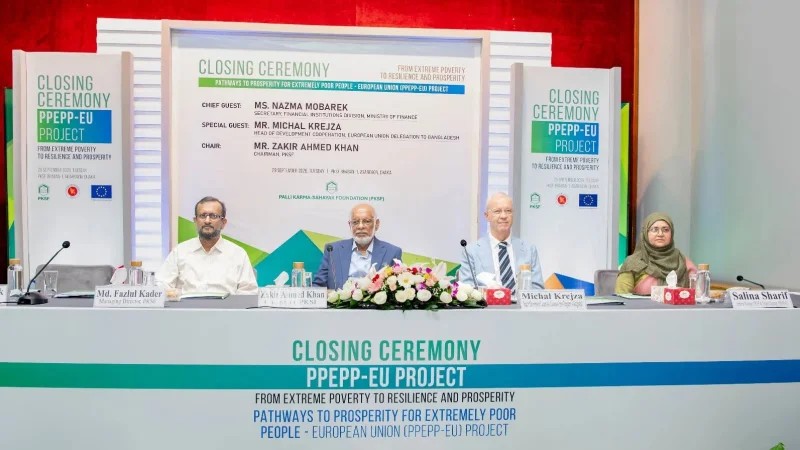
At the closing ceremony of the four‑year PPEPP‑EU project—running from October 2022 to September 2026 and financed by the European Union—speakers offered these observations.
The event taking place today at the PKSF Bhaban in Agargaon, Dhaka, was chaired by PKSF chairman Zakir Ahmed Khan.
Michal Krejza, head of development cooperation for the European Union Delegation in Bangladesh, attended the event as a special guest.
PKSF managing director Md Fazlul Kader delivered the welcome address, and Salina Sharif, PKSF’s general manager and project director of the PPEPP‑EU initiative, provided an overview of the project.
The chief guest, Nazra Mobarek, secretary of the Financial Institutions Division of the Ministry of Finance, had her speech read aloud at the event.
Mobarek said that extreme poverty is a multidimensional reality and is not merely a matter of insufficient income or assets.
She said that an important lesson from the PPEPP‑EU programme is that the ultimate aim of poverty reduction is not dependence on assistance but the development of capability and self‑reliance. She added that when financial support, skills training, market linkages, health and nutrition, social protection and climate‑resilience measures are addressed in an integrated way, even the most destitute individuals can gradually become producers, entrepreneurs and active participants in the economy.
Michal Krejza emphasized the European Union’s contribution to the project and underscored the need to build on its achievements and outcomes.
He said: “A project should not end when the project funding ends. The ultimate measure of success will be whether the gains achieved by these households can be sustained — whether their businesses and livelihoods continue to grow, whether their assets continue to increase, whether their children remain better nourished. We are therefore encouraged by PKSF’s commitment to mainstreaming PPEPP participants into its regular credit programmes, and by the continued engagement of its Partner Organisations.”
PKSF chairman Zakir Ahmed Khan said the greatest achievement of the PPEPP‑EU programme is not merely its specific project outcomes, but also its role in creating opportunities that enable people to strengthen their capabilities and confidence and to advance on their own path to development.
He added that there had been significant doubts about whether members of the ultra‑poor could become eligible for and effectively use credit. The project, however, has shown that with appropriate support, the ultra‑poor can develop the capacity to access credit, which can contribute to sustainable, long‑term poverty reduction.
PKSF managing director Md Fazlul Kader said that in the four years since the project began, more than three‑quarters of the extremely poor households it targeted have risen above the extreme‑poverty line, and a sizable share have become micro‑entrepreneurs.
Alongside a grant of €22.81 million from the European Union, roughly Tk3,217 crore in affordable loans was disbursed to project households through PKSF and its partner organisations.
A presentation on the project indicated that integrated services reached roughly 860,000 individuals from 215,000 ultra‑poor households. The assistance was delivered through 19 partner organisations operating in 145 unions across 34 upazilas in 12 districts.
The proportion of extremely poor households among project participants declined from 62.7% to around 22%.
The proportion of children under five experiencing stunting fell from 48 % to 22.8 %, a level that now sits below the national average.
The prevalence of wasting also declined from 17% to 12.4%.
Why it matters
The successful conclusion of the PPEPP-EU project demonstrates the effectiveness of integrated development models in permanently lifting vulnerable households out of extreme poverty in Bangladesh.