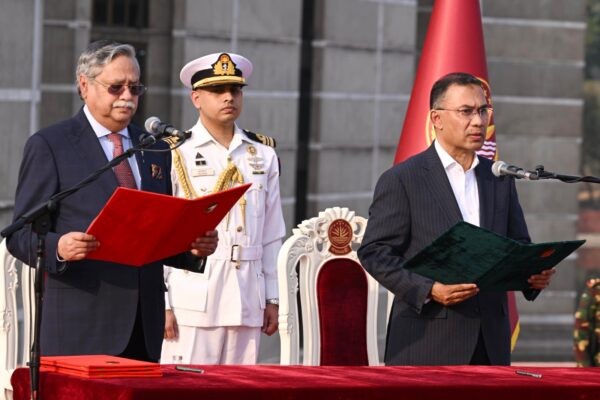
Tarique Rahman had served as Bangladesh’s prime minister for only 11 days when a war erupted in the Middle East.
He assumed office on February 17, and subsequently, on February 28, the United States and Israel launched an attack on Iran.
By March, disrupted fuel supplies had forced Bangladesh to introduce rationing, putting further pressure on its economy.
Eight months into Bangladesh Nationalist Party (BNP) rule, the results are mixed.
But living costs keep rising, businesses remain cautious, and law and order remains a concern.
The government inherited serious problems, but its decisions also need to be examined.
Constitutional reforms endorsed in a referendum alongside February’s national election remain under negotiation.
New rights laws have drawn criticism for weakening independent oversight.
How far is the BNP willing to change the institutions it now controls?
And are its decisions making people’s lives better, safer, and freer than before?
Crime and Law and Order Law and order remains a concern eight months into BNP rule.
Bangladesh Police’s monthly statistics indicate that the number of murder, robbery and kidnapping cases recorded between March and September was lower than in the same period of 2025.
Burglary cases, however, increased, while mob killings continued.
During the eight‑month period, police recorded 2,122 murder cases, down from the 2,317 cases logged in the same span a year earlier.
Robbery cases fell from 1,159 to 1,077, while kidnapping cases declined slightly, from 628 to 618.
Burglary cases rose from 1,796 to 2,022, an increase of nearly 13 percent.
The total number of registered cases increased by 14 percent, from 110,296 to 125,763.
Narcotics cases accounted for about 90 percent of that increase, rising from 31,111 to 45,091.
The rise in figures alone does not demonstrate whether drug offenses have become more prevalent or whether police have simply become more active in recording them.
A review of cumulative reports compiled by Ain o Salish Kendra, a human‑rights organization based in Dhaka, indicates that 131 people were killed in mob‑beating incidents between March and August 2026. The figure reflects the total number of deaths recorded in the organization’s documentation for that period.
On 11 April, a mob killed a Sufi spiritual leader in Daulatpur Upazila, Kushtia, after allegations that he had insulted religion.
His shrine was vandalized and set on fire.
Media reports said law enforcement personnel were present but failed to control the attack.
On 25 September, more than 200 masked assailants looted and razed the Radda MCH‑FP Center, a maternal and child health facility in Dhaka.
A preliminary police investigation concluded that officers were present at the scene but did not intervene to stop the looting. The report noted the presence of law‑enforcement personnel during the incident, yet no action was taken to halt the criminal activity.
A day later, hundreds of attackers stormed a property and vandalized content creator Salman Muqtadir’s studio.
Police linked the attack to a land dispute involving the property owner.
In June, a mob assaulted two officers in Savar and freed a suspect.
In July, three police officers were attacked in Kutubdia while taking a suspect into custody.
On September 5, Special Branch Sub-Inspector Altaf Hossain was beaten to death in Savar.
More recently, on October 10, a police inspector was seriously injured in an attack by muggers in Khulna.
On 26 August, Home Minister Salahuddin Ahmed said that suspects in nearly all criminal cases filed during the first six months of the government’s term had been arrested within a reasonable period.
He said the administration had inherited a fragile security situation and was working to improve police morale.
According to court records cited in media reports, 723 extortion cases were lodged at 49 police stations in Dhaka between January and August, a period that included several weeks before the Bangladesh Nationalist Party (BNP) assumed office.
Md Tawohidul Haque, an associate professor and crime analyst at the Institute of Social Welfare and Research, University of Dhaka, said the government’s law‑and‑order record is mixed. “We cannot say that there has been any significant improvement compared with the previous one and a half years,” he said.
At the same time, we cannot say that the situation has deteriorated dramatically,” he told The Diplomat.
Haque said the limited progress was due in part to inconsistent enforcement and the government’s failure to control its own personnel, stating, “Unless a political party takes a firm position against wrongdoing within its own ranks, the situation will not improve.” He also questioned who drug enforcement was actually reaching.
While drug users, small retailers and couriers were arrested, influential figures continued to benefit from political protection, the official said. “The real patrons and powerful figures behind the drug trade remain beyond the reach of the law,” he argued. He added that such protection could only be removed through deeper reforms in policing, noting, “The Bangladesh Police has still not been depoliticized,” and that “its internal structure also remains largely unchanged.”
During the Bangladesh Nationalist Party’s first months in office, inflation eased, but the improvement was uneven.
In March, consumer prices were 8.71 percent higher than a year earlier.
Inflation rose to 9.42 percent in May before easing to 8.34 percent in September, a level just below the 8.36 percent recorded in September 2025.
Prices were still rising, adding to costs households had already absorbed.
In August, the Bangladesh Bureau of Statistics’ wage index rose by 8.05 percent, a rate that lagged behind the nation’s inflation.
The index covers selected lower-paid occupations, including agricultural laborers, construction workers, and transport workers.
According to the data, these workers’ wages still bought less than they did a year earlier, even though the pace of price increases has slowed.
There was more encouraging news from Bangladeshis working abroad.
Remittances totaled $18.94 billion for the period from March through August, marking a 13.1 % rise compared with the same months in 2025, Bangladesh Bank said.
These inflows helped replenish foreign exchange reserves and supported families receiving money from overseas.
The improvement continued a rise in remittances that had begun before the BNP took office.
Bankers interviewed by The Business Standard (TBS), a Bangladeshi daily, said that demand remains weak, borrowing costs are high and the country is facing energy shortages.
Hussain, the managing director of Bank Asia, told TBS that factories were operating below capacity, leaving businesses with little incentive to fund expansion.
The return of an elected government has yet to produce a strong recovery in borrowing.
Bangladesh Bank had maintained tight monetary policy, while loan defaults continued to constrain lending.
In its July–December policy statement, the authority noted that raising interest rates by itself would be insufficient to curb inflation that stems from market disruptions and supply‑chain problems.
It also announced a 600 billion taka financing package for industry, agriculture, and smaller businesses.
The government increased the price of diesel to 135 taka per litre, up from 115 taka, saying the rise reflects higher international energy costs caused by the conflict in the Middle East.
The Energy Ministry said the increase was needed to reduce losses at the state petroleum corporation.
The development threatened higher production and transport costs for both businesses and households, making the recent easing of inflation more difficult to sustain.
The government is also struggling to fund its spending plans.
Bangladeshi daily Banik Barta reported that the record budget of 9.38 trillion taka depends on collecting nearly 7 trillion taka in revenue.
Yet collections are falling as economic activity slows.
According to sources from the National Board of Revenue, the newspaper reported that revenue for July–August was 518.9 billion taka, down from 547.7 billion taka in the same period a year earlier and 291.6 billion taka below the target for those two months.
At the same time, rising costs for imported energy, expanded subsidy programmes, higher public‑sector wages and the commitment to major projects are increasing overall expenditure.
Industrial economist and policy analyst Khondaker Golam Moazzem, who serves as president of the Knowledge Hub Institute, said that high inflation, weak growth and rising unemployment indicate economic stagnation.
He said the government had shown insufficient interest in the structural reforms required for recovery. “The problem is that the government lacks the revenue support needed to finance these activities,” he told The Diplomat, referring to its expanding spending commitments.
Moazzem questioned the timing of salary increases for government employees and large projects that he believed could be postponed.
One such example is the large expansion of Biman Bangladesh Airlines’ fleet.
The carrier has placed orders for 25 Boeing aircraft from the United States and 10 Airbus jets from the European Union, bringing the total to 35 new aircraft, against a current fleet of just 19.
Moazzem cautioned that, without reforms to the airline’s management and service quality, the massive purchases could impose a long‑term debt burden on Biman that would be difficult to service.
New spending commitments are adding pressure at a time when businesses and households were already struggling, he added.
High inflation, borrowing costs, and an uncertain business environment also discouraged private investment.
Acknowledging the challenges inherited by the Bangladesh Nationalist Party (BNP), he said these could not indefinitely excuse its performance. “After all, this government assumed office with the promise of reversing the economic deterioration,” Moazeem said.
According to Foreign Policy, eight months into his premiership, Rahman has visited Malaysia, China and the United Nations General Assembly in New York, but he has not yet traveled to India.
The postponement highlights the difficulty of restoring relations with New Delhi while Prime Minister Sheikh Hasina remains in the Indian capital.
Her political activities carried out from India, along with Dhaka’s demand for her extradition, continue to complicate attempts to schedule a visit.
Speaking in Dhaka on 3 October, Indian High Commissioner Dinesh Trivedi said that Prime Minister Sheikh Hasina’s return is contingent on a legal process and offered no timetable for when it might occur.
His comments gave no indication that the principal dispute between the two nations would be settled in the near term.
Rahman declined to attend the BRICS Summit’s outreach session, after Dhaka protested that the invitation referred to him as the BIMSTEC chair rather than as Bangladesh’s prime minister.
India replied that it had issued two separate invitations, including one for a bilateral visit.
Behind the protocol dispute lie practical concerns, with Bangladesh pressing for progress on visas, trade restrictions and water‑sharing arrangements.
The Ganges water treaty is set to expire in December, a development that has heightened the urgency of the related discussions.
During Rahman’s June visit, Beijing expressed support for cooperation on the development of Mongla Port, the Chinese Economic and Industrial Zone in Chittagong, and the Teesta River management project.
The two governments said they will explore opening a dialogue between their foreign and defence ministries, indicating a desire for closer security coordination alongside investment.
The Teesta River project is of particular interest.
The joint communiqué pledged Chinese assistance and an acceleration of feasibility work, while making clear that no finalized financing arrangement had been announced.
Nevertheless, managing the river within Bangladesh would not resolve the distinct dispute with India. The disagreement concerns the sharing of the Teesta’s water.
Beijing’s backing has given Dhaka an alternative means to advance a long‑delayed project. Nevertheless, negotiations with New Delhi remain essential.
The government pursued closer ties with the United States through purchases as well as diplomacy.
On 23 September, during Tarique’s visit for the United Nations General Assembly, Bangladesh’s national carrier Biman Bangladesh Airlines placed an additional order for 11 Boeing aircraft, raising its total aircraft orders for the year to 25.
Biman said the acquisition is part of its fleet‑renewal programme, but it also serves a broader diplomatic objective: boosting U.S. imports to ease trade tensions and protect Bangladesh’s garment exports from further tariff pressure.
The main Bangladesh-U.S. tariff agreement, however, was inherited by the BNP as a fait accompli.
The agreement, announced on February 9, two days before the election, establishes a 19 percent tariff on U.S. goods and incorporates a mechanism that grants preferential treatment to a specified volume of garments, contingent on purchases of U.S. textile inputs. The preferential treatment applies solely to that defined garment volume and is directly linked to the procurement of U.S. textile materials.
It also locked Bangladesh into substantial agricultural and energy purchase commitments.
The Rohingya crisis remains a focal point for Bangladesh’s foreign policy.
During the United Nations General Assembly in September, Rahman called for a credible plan to enable the voluntary return of refugees, for the protection of refugees’ rights in Myanmar, and for reliable humanitarian funding.
He also acknowledged that people were still fleeing violence into Bangladesh.
Rahman also sought international backing for his government’s domestic agenda.
He presented a strategy centered on “recovery, restoration and reconstruction” and called on development partners to assist in supporting jobs and expanding manufacturing.
He called for continued market access and financing as Bangladesh prepares to graduate from least-developed country status.
In his address, he identified economic recovery as a core foreign‑policy priority, while also calling for climate finance and a durable resolution to the Rohingya crisis.
In October and November, Rahman is scheduled to visit Japan and Saudi Arabia on bilateral trips, as well as travel to Türkiye to attend the 31st U.N.
The political environment and freedom of expression were marked by open arguments between the government and its former allies during the BNP’s first months in office. These disputes underscored the tensions within the coalition at that early stage.
Jamaat-e-Islami, now leading the parliamentary opposition, challenged the government’s claims of success.
In August, its 11-party alliance questioned the handling of rising prices, energy shortages, and public safety.
National Citizen Party leader Nahid Islam has also charged the government with denying the opposition the chairmanships of parliamentary committees, thereby restricting its capacity to scrutinise those in power.
These disputes showed that political competition was continuing after the election.
The interim government’s order of May 2025 continues to prohibit the Awami League’s activities, pending the trial of its leaders and activists before the International Crimes Tribunal.
The restrictions extended beyond rallies and meetings to publications and online publicity.
The BNP inherited the ban, but chose to uphold it.
That left a major segment of Bangladeshi citizens without the ability to organize through their preferred party.
Journalists continued to face attacks, threats and legal pressure.
Ain o Salish Kendra recorded 242 incidents of journalist harassment between March and September.
The category includes several forms of abuse and does not mean that the government was responsible for every incident.
It nevertheless documents the risks that persisted after the elected administration took office.
The treatment of detained political opponents also drew criticism.
In August, Human Rights Watch reported that hundreds of individuals linked to the former Awami League government remained detained without charge, noting that none of the detainees had been formally accused of any crime.
According to the report, at least ten Awami League office holders have died in prison since the Bangladesh Nationalist Party assumed office, most of them having not been charged with any offence.
Families and lawyers have alleged that detainees are being denied adequate medical care and that fresh cases are being filed to prevent their release after bail orders have been issued.
Human Rights Watch, while noting that certain former officials have faced allegations of serious abuses, urged that each detention be reviewed individually and that independent investigations be conducted into every prison death.
Proposed changes to the cyber law added to concerns over media freedom.
In September, the Committee to Protect Journalists warned that draft amendments could expose journalists to prison terms of up to ten years for circulating material that authorities consider rumors or misinformation.
The authority also warned that courts may suspend or cancel the licences of news outlets that publish reports challenging its accounts.
The government said the amendments were not intended to target journalists.
Following objections from editors and media organizations, it agreed in late September to form two committees to recommend safeguards.
Shahan, a professor of development studies at the University of Dhaka and a political analyst, said the concerns reflected a broader issue.
He cautioned that recent amendments to cybersecurity legislation and the erosion of human‑rights oversight could bolster the government’s capacity to target its critics. “We are seeing the beginnings of institutional mechanisms that could be used to weaken the opposition and dissenting voices,” he told The Diplomat.
Nur Khan Liton, a human‑rights activist, said that eight months is too brief a period for a definitive assessment, though he observed some improvement compared with the era of Awami League rule. “In some areas, we have seen substantial efforts by the government,” he said.
Even so, it has no alternative but to take firmer action,” he told The Diplomat.
Liton pointed to alleged extrajudicial killings, deaths that occurred while in police custody or in prison, and attacks on Hindu communities.
Mob violence remained a persistent concern. He observed, “We are witnessing people being labeled in different ways and then subjected to violence by mobs.”
He referred to the incident that occurred on 26 September at the headquarters of the Jatiya Samajtantrik Dal (JASAD), also known as the National Socialist Party, in Dhaka.
The party claimed that activists from the Bangladesh Nationalist Party (BNP) and its youth wing, Jubo Dal, assaulted participants at a scheduled meeting, after which police detained a large number of people.
Police said they were acting on intelligence that Awami League members had gathered at the site, a claim that the Jatiya Samajtantrik Dal (JASAD) rejected.
Liton characterized the incident as both undemocratic and unlawful, noting that he had observed no legal action taken against the attackers.
Liton also questioned whether recent legal changes would leave people with fewer protections against state abuse.
He said the new legislation governing the National Human Rights Commission and the handling of enforced disappearances is weaker than the measures it replaced.
In his assessment, they would limit the commission’s ability to respond to violations by law enforcement agencies.
He warned that the draft cyber legislation could further curtail freedom of expression, even as assaults on media personnel persisted. “We cannot say unequivocally that journalists are safe under this government,” he said.
By late September, the government was still conducting consultations on the constitutional reforms that voters had approved in the February referendum.
The proposals called for imposing term limits on the prime minister, creating a second chamber of parliament and strengthening safeguards for judicial independence.
On September 29, Home Minister Salahuddin Ahmed said the parliamentary committee aimed to finish discussions by December.
A report and an amendment bill are slated to be issued at a date that has not yet been determined.
Disagreement over the reform package began almost immediately after the election.
The implementation order of the July Charter stipulates that elected members of parliament will convene as a separate Constitutional Reform Council. The council is mandated to finalize constitutional reforms within 180 working days from its inaugural session.
Bangladesh Nationalist Party (BNP) lawmakers refused to take the council oath, contending that any changes must be made in accordance with the existing constitution.
Lawmakers from Jamaat‑e‑Islami and the Nationalist Congress Party took their oaths and reiterated that the referendum must be pursued through the council route.
The timetable was thus tied to a process the parties could not agree to begin.
The government instead formed a parliamentary committee in July, leaving five places for opposition nominees.
This dispute also concerned who would determine the substance of reform.
The BNP said its objections, recorded when the charter was signed, must be respected, while its opponents countered that the referendum provided a mandate for implementation.
On 29 September, Salahuddin said he was prepared to allow compromise on the objections, on the condition that opposition parties take part in the talks.
He reiterated his backing for a ten‑year cap on any individual’s premiership, while noting that the composition of the caretaker government remains undecided.
Other institutions had seen action, although that did not always amount to the changes promised.
New appointments in August restored the Anti-Corruption Commission’s leadership after a 168-day vacancy.
That allowed it to resume work on accumulated complaints and investigations.
The Center for Governance Studies’ Reform Watch observed that the independent appointment mechanism outlined in the charter was not established.
Restoring an institution’s functioning and reducing political influence over it are separate tasks.
September’s legislation raised a more serious question about the direction of reform.
Parliament passed laws on the National Human Rights Commission and enforced disappearances on September 6.
The disappearance law provided for prosecution, victim support, and compensation.
Yet it placed investigations involving security forces with another force chosen by the government, rather than the independent commission.
Human Rights Watch argued that this reversed protections introduced under the interim government.
The commission also condemned the imposed restrictions on its ability to investigate security agencies directly, as well as the reinstatement of government influence over appointments.
The restructuring of the Rapid Action Battalion drew similar criticism.
In September, legislation abolished the Rapid Action Battalion and created the Special Response Battalion, moving the former’s personnel, powers and property to the new unit.
Human Rights Watch said the change lacked adequate provisions for independent oversight and accountability.
Families seeking answers to disappearances and killings continue to face the practical question of whether investigators can scrutinise security agencies without relying on those agencies’ cooperation.
Eight months after the BNP assumed power, negotiations on promised constitutional reforms were still ongoing. Meanwhile, several statutes already enacted are being challenged for preserving powers that the reform was meant to limit.
University of Dhaka professor Shahan said that holding an election is only the first step in the effort to rebuild democracy.
Institutions also required independence to check government power. “I do not see any clear direction regarding how the government actually intends to build democratic institutions,” he told The Diplomat.
Shahan warned that, after only eight months, it is premature to render a definitive judgment, and he added that attempts to diminish independent oversight are cause for concern.
Shahan expressed concern that the BNP would select reforms according to its own political interests, even though voters had approved the changes in the February referendum.
He referenced the plan to create a separate administrative office for the Supreme Court, a measure intended to lessen the Court’s reliance on the government.
The BNP had not formally opposed the proposal, although it was not progressing. “I think the BNP will ultimately proceed according to its own preferences and priorities,” Shahan said.
Why it matters
An evaluation of the BNP administration's first eight months highlights the ongoing domestic and international challenges shaping Bangladesh's political and economic trajectory.