Durga Puja, the largest religious festival of Bengali Hindus, concluded on October 21. Hindus celebrated the festival peacefully throughout the Muslim-majority country, with no major incidents reported.
The Bangladesh Nationalist Party (BNP) government passed its first major test of communal harmony since taking office in early 2026.
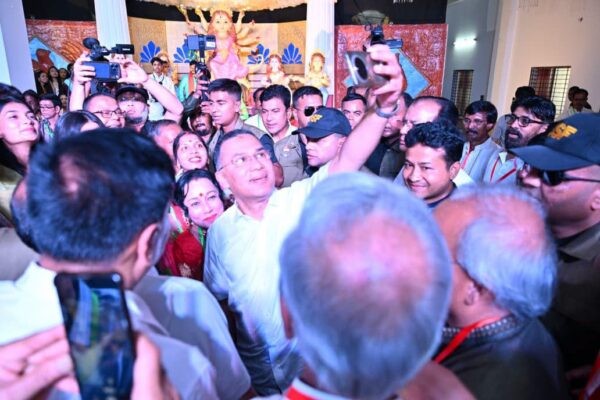
Prime Minister Tarique Rahman also drew attention by visiting puja pandals in several divisional cities outside Dhaka, becoming the first Bangladeshi prime minister to do so.
Beyond the celebrations, this year’s Durga Puja highlighted a significant shift in Bangladesh’s political landscape.
The long-held perception that religious minorities are safer under the Awami League now appears to be on the verge of breaking down.
A Test for the BNP Durga Puja is celebrated on a large scale in both Bangladesh and the neighboring Indian state of West Bengal.
West Bengal, which has a population of roughly 100 million people that includes around 70 million Hindus, saw nearly 58,000 puja pandals set up across the state this year.
Meanwhile, Bangladesh has approximately 13.1 million Hindus and hosted 33,851 puja pandals, which is about 1,500 more than the previous year.
This means Bangladesh had more puja pandals relative to its Hindu population than West Bengal.
This was the first Durga Puja celebrated under the BNP government, which came to power in February this year.
As a result, the festival carried significance beyond that of a religious celebration.
In particular, the situation represented a test of the new government’s ability, political will, and commitment to ensure the security of religious minorities.
Some untoward incidents have occurred during the festival over the years.
This year was no exception in the period leading up to the formal commencement of the festivities, with several incidents reported in different parts of the country.
Given the precarious law and order situation, there were concerns that such incidents might escalate.
Nevertheless, the BNP government successfully met the challenge of ensuring that Durga Puja was celebrated peacefully.
Representatives of the Hindu community had long demanded three days of public holidays for Durga Puja.
During the Awami League’s rule, there was one public holiday on Bijaya Dashami.
Following the political transition in 2024, the interim government led by Muhammad Yunus increased the holiday to two days.
This year, the BNP government extended it to three days.
Following public holidays from October 20 to 22, which were followed by weekly holidays on October 23 and 24, people enjoyed a continuous five-day break.
The government also allocated more financial assistance than was requested in order to encourage a festive atmosphere during the celebrations.
While the Hindu Religious Welfare Trust sought 40 million Bangladesh taka for Durga Puja, the government allocated 50 million.
Similarly, for the Buddhist community's Kathina Civara Dana, the government allocated 30 million taka against a request for 20 million.
The significance lay not in the amount of money but in the message conveyed by the government.
Netizens described this year’s Durga Puja as having been celebrated with unprecedented security arrangements and a festive atmosphere.
On October 20, during Durga Puja, Rahman visited puja pandals in the capital, Dhaka, as well as in three other divisional cities: Rangpur, Rajshahi, and Chittagong.
Rahman exchanged greetings with members of the Hindu community and listened to their concerns.
Earlier, in his Durga Puja greetings message on October 16, Rahman urged Hindus to celebrate the festival with joy and confidence, free from fear.
Rahman emphasized religious harmony, mutual respect, and equal rights for all citizens, regardless of their faith. “Religion belongs to individuals, while the state belongs to all,” he said, stressing that ensuring everyone’s security is a responsibility of the state.
He also spoke of building a safe and inclusive Bangladesh where people of all religions and communities can live with dignity.
These comments were significant in Bangladesh’s political context.
Many have historically viewed a large section of the Hindu community as supporters of the Awami League.
In contrast, there have long been attempts to portray the BNP as a relatively conservative political party, which has previously formed alliances with Jamaat-e-Islami, though the BNP, as a party, believes in liberal democracy.
While visiting a puja pandal in Dhaka’s Banani area on October 16, Home Minister Salahuddin Ahmed told members of the Hindu community that they did not need to be anyone's vote bank. He urged them to base their political decisions on their civil rights, religious freedom, and constitutional entitlements.
Ahmed also remarked that various political parties had exploited the Hindu community for political gain in the past.
His statement carries considerable significance in Bangladesh’s political landscape.
Although the Awami League has been perceived as a relatively safe political refuge for minorities, numerous instances of attacks and discrimination against minority communities occurred during the party’s long tenure in power.
These include the attacks on the Buddhist community in Ramu, Cox’s Bazar, in 2012; the attacks on Hindu homes and temples in Nasirnagar, Brahmanbaria, in 2016; and the communal violence that spread from Cumilla during Durga Puja in 2021.
State Department’s human rights report, six people were killed in the 2021 violence.
These incidents demonstrated that the Awami League was not necessarily effective in protecting religious minorities.
According to the 2022 Population and Housing Census, Hindus accounted for 7.96 percent of Bangladesh’s total population, marking a decrease from 8.54 percent recorded in the 2011 census.
The Bangladesh Bureau of Statistics (BBS) has identified migration, along with a lower fertility rate, as a contributing factor behind the declining proportion of Hindus in the population.
Following the fall of the Awami League government in August 2024, allegations emerged of attacks on minorities, vandalism of homes and businesses, and assaults on places of worship in different parts of the country.
Although the fact-finding team of the Office of the United Nations High Commissioner for Human Rights (OHCHR) determined that political rather than communal motives drove most of these incidents, neighboring India has persisted in expressing concern regarding the situation.
According to the OHCHR’s 2025 fact-finding report, the violence was driven by several factors, including religious and ethnic discrimination, political revenge against people seen as Awami League supporters, land disputes, and personal conflicts.
The report also found that some local BNP and Jamaat-e-Islami leaders and activists were involved in the attacks.
However, it found no evidence that either party had organized the attacks as part of party decision.
Under the heading "The Bigger Picture," the Awami League was barred from participating in the national election that took place on February 12 of this year.
Of the 300 elected parliamentary seats, the BNP won 209, while Jamaat-e-Islami secured 68.
The results showed that the BNP gained strong support in many Hindu-majority areas that were traditionally considered Awami League strongholds.
Netra News analyzed results and voter records from more than 40,000 polling stations.
Of these, 1,088 were located in areas where more than half of the voters were inferred to be Hindu, based on an analysis of their names appearing on the electoral rolls.
The BNP led in 984 of these polling stations, securing 69.1 percent of the valid votes cast, compared with 14.9 percent for Jamaat-e-Islami.
These figures suggest that minority voters migrated to the BNP after the Awami League was banned.
In this year’s election, only four candidates from religious and ethnic minority communities—comprising two Hindus and two Buddhists—were elected to parliament. All four candidates were nominated by the BNP.
Four more women from minority communities were later nominated to parliament through reserved seats, also representing the BNP.
This brings the total number of minority lawmakers to eight.
Their representation remains low compared with the share of religious and ethnic minorities in Bangladesh’s population.
The situation demonstrates that additional measures are required to guarantee meaningful political representation for minority communities, moving beyond mere symbolic inclusion.
The peaceful conclusion of Durga Puja should not overshadow concerns about incidents reported before the festival.
On October 15, the Bangladesh Puja Udjapan Parishad and the Mahanagar Sarbajanin Puja Committee reported 34 alleged incidents across the country, which included damage to idols, attacks on temples, and other acts of violence.
The organizations said arrests had been made in 11 of these cases.
Bangladesh Police said investigations into several of the incidents found no evidence of plots to disrupt communal harmony. The statement was issued after a series of communal tensions were reported across the country, with authorities confirming that probes into specific cases did not uncover any organised attempts to disturb public order.
Instead, they pointed to local leadership disputes, theft, and other causes.
Even so, transparent and credible investigations into all the allegations remain important, and those responsible must be brought to justice.
According to the Bangladesh Hindu Buddhist Christian Unity Council, 257 incidents of communal violence were reported across Bangladesh between January and June 2026, a timeframe that includes the tenures of both the interim government and the BNP government.
The organization said 44 people were killed in 40 of these incidents.
The India Dimension The changing political situation of religious minorities in Bangladesh also has implications for relations with India.
Minority security has long been a sensitive issue between the two countries.
During Sheikh Hasina’s rule, close ties between Dhaka and New Delhi were shaped not only by security and strategic cooperation but also by the Awami League’s self-claimed secular political image.
However, Bangladesh-India relations became strained after Hasina fled to India and took refuge there in 2024.
Even under Bangladesh’s current elected government, disagreements over Hasina, border issues, trade and water sharing remain unresolved.
Even so, this year’s Durga Puja celebrations have drawn approval even from some Indian critics who have long raised concerns about minority security in Bangladesh.
Among them is Kolkata-based journalist Mayukh Ranjan Ghosh, who praised the scale and grandeur of the celebrations.
Such reactions suggest that perceptions of Bangladesh may be beginning to change across the border.
Whether this development will lead New Delhi to reconsider its longstanding political suspicion of the BNP remains to be seen.
Much will depend on whether the BNP government can sustain the same sense of security and confidence among religious minorities beyond the festival.
Why it matters
The peaceful observance of Durga Puja under the new administration signals a potential shift in the political alignment and security of religious minorities in Bangladesh.