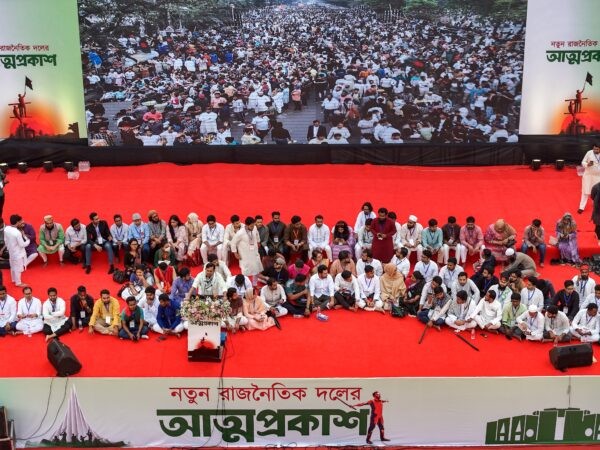
On September 19, National Citizen Party (NCP) convener Nahid Islam sharply criticized Prime Minister Tarique Rahman.
Rahman would eventually have to choose how to leave power, he said, adding that he must decide whether to flee the country by helicopter or resign with dignity.
Nahid was not speaking at an NCP rally.
He was addressing a long march organized by the Jamaat-e-Islami (JI)-led 11-party opposition alliance to press a seven-point demand, which included the implementation of the February referendum verdict, action on rising prices, the energy and fertilizer crisis, deteriorating law and order, and corruption.
JI chief Shafiqur Rahman spoke at the same gathering.
This has become a familiar picture in Bangladesh, where NCP routinely joins JI in long marches, alliance meetings and parliamentary protests.
The NCP emerged from the student protests that brought down the Awami League government in August 2024.
For a party that entered politics promising a new political alternative, this raises a basic question.
NCP says the relationship is strategic, not ideological.
Less than two years after emerging from the student-led uprising, the party is struggling to show voters what still makes it politically distinct.
When NCP was launched in February 2025, it carried a heavy political promise.
Its leaders had come directly from the student movement that helped bring down Sheikh Hasina’s authoritarian rule.
Many were young, had never held party office, and spoke about building a political system different from the one Bangladesh had known for decades.
At its launch, the NCP called for a new constitution and a “Second Republic.” It promised democratic institutions, an end to corruption and nepotism, and politics based on equality and representation.
The party presented itself as a centrist force and an alternative to the older parties that had dominated Bangladesh.
Less than two years later, NCP is in parliament.
But how it arrived there has created a more difficult question.
Can it still convince voters that it represents something genuinely new?
The turning point occurred prior to the February 2026 national election, when the NCP entered into an electoral alliance led by JI.
For a new party without a strong nationwide organization, the calculation was understandable.
Elections in Bangladesh require candidates, polling agents, local networks, money and organization across hundreds of constituencies.
NCP had enthusiasm and recognizable leaders, but it did not have the machinery of an established party.
But JI’s history made the NCP’s choice contentious.
The party had sided with Pakistan against Bangladesh’s independence in 1971, and some of its leaders and members had collaborated with Pakistani forces during the genocide.
So, the deal came with a political cost.
Before coming to an agreement with JI, the NCP held seat-sharing talks with the Bangladesh Nationalist Party (BNP), while also considering a separate third alliance.
The NCP reportedly sought at least 20 seats from the BNP, but the party was willing to offer only around six or seven, with some NCP leaders stating that the final number could potentially fall to three.
JI, meanwhile, was prepared to offer around 30 constituencies.
For a new party still struggling to build a nationwide organization, the JI deal offered a much clearer path into parliament.
However, in the JI-led alliance, JI received by far the largest share.
According to media reports, the decision caused serious resistance inside the NCP.
At least 30 senior members either resigned or publicly opposed the alliance.
Tasnim Jara, one of the party’s best known figures, left the NCP before the election.
By the NCP’s first anniversary in February, at least 60 leaders and activists had resigned from the party during its first year.
Not all leftover members joined the JI, but the electoral alliance became the clearest public sign of an internal disagreement over what the NCP was supposed to become.
NCP leaders have consistently rejected the idea that this means ideological integration with JI.
In a March 2026 interview with The Diplomat, Nasiruddin Patwary, Chief Coordinator of the NCP, stated that the party had wanted to work with the BNP.
But disagreements over reform and electoral realities pushed the party toward JI.
He stated that the religious ideology of JI did not represent the position of the NCP. Furthermore, he argued that if the two parties shared the same political beliefs, the NCP would have simply joined JI.
In the February election, NCP won only six parliamentary seats.
JI won 68 while the 11-party coalition won a total of 77 seats among 300.
For a party less than a year old, six MPs cannot simply be dismissed as failure.
But the numbers also show the limits of NCP’s rise.
It had emerged from a national uprising and once hoped to compete across Bangladesh.
Instead, it entered parliament after contesting in only a small part of the country under a seat-sharing arrangement dominated by JI.
Some young Bangladeshis saw the alliance as a retreat from the politics NCP had originally promised.
It lacked the resources, organization and local structure enjoyed by older parties.
The bigger challenge is what happened after the election.
The partnership with JI did not end when voting ended.
JI chief Shafiqur Rahman became leader of the opposition.
NCP convener Nahid Islam became opposition chief whip.
The two parties remained together in the opposition bloc.
But voters do not judge political identity only through party constitutions or official statements.
They also see who shares platforms, who coordinates parliamentary action and who campaigns together on the streets.
As the NCP continues to operate within the JI-led bloc, it may become increasingly difficult to articulate the political distinctions that set the NCP apart from the surrounding alliance.
Other controversies have also hurt the NCP's image.
Spokesperson Asif Mahmud Shojib Bhuyain, a former interim government adviser, is under investigation by the Anti-Corruption Commission (ACC) over allegations that include abuse of power and the accumulation of illegal wealth.
The ACC has said the allegations are not yet proven, while Asif has rejected them.
NCP’s student wing Jatiya Chhatra Shakti (JCS) has also faced scrutiny.
In March, a Dhaka University student accused JCS activists of beating him.
In August, its activists were involved in a clash with the Bangladesh Jatiyatabadi Chhatra Dal, the BNP’s student wing, and Bangladesh Islami Chhatra Shibir, the student wing of JI, at Jagannath University in Dhaka, which left at least 70 people injured.
NCP had promised a different kind of politics.
Incidents like these raise questions about how different it really is.
NCP has also struggled to show what is genuinely new about its politics.
Much of the group's agenda continues to focus on constitutional reform, criticism of India, and street programs that frequently take place alongside JI.
The two parties frequently use similar language about sovereignty, foreign influence, and reform.
The NCP has provided fewer detailed answers regarding issues such as inflation, jobs, energy shortages, and the broader economic pressures confronting ordinary Bangladeshis.
The contrast was visible after Bangladesh signed its trade agreement with the United States on February 9, just three days before the national election.
Economists and civil society figures quickly raised questions regarding the timing, lack of transparency, and potential impact of the development on Bangladesh’s economic and strategic independence.
NCP, however, did not make the agreement a major political issue in the immediate aftermath of its signing.
Its criticism became clearer only later, when party leaders called for revisions and raised concerns directly with the U.S. ambassador.
If sovereignty and foreign influence are central to the NCP’s criticism of Delhi, why did an agreement with Washington receive much less attention at the beginning?
With all its shortcomings, it would still be premature to write off the NCP.
The NCP still has six lawmakers, while Nahid Islam serves as opposition chief whip.
The party also plans to contest the upcoming local government elections independently rather than as part of an electoral arrangement with JI.
Those elections could provide a clearer picture of NCP’s own political strength.
The national election showed that an alliance with JI could help the party enter parliament.
Contesting separately will show how much support NCP can attract under its own name.
However, for now, its future depends entirely on whether it can step out of the shadows and prove it is an independent force, rather than just a junior partner in a JI-led coalition.
Why it matters
The political trajectory of the NCP shapes the evolution of post-uprising political pluralism and opposition dynamics in Bangladesh.