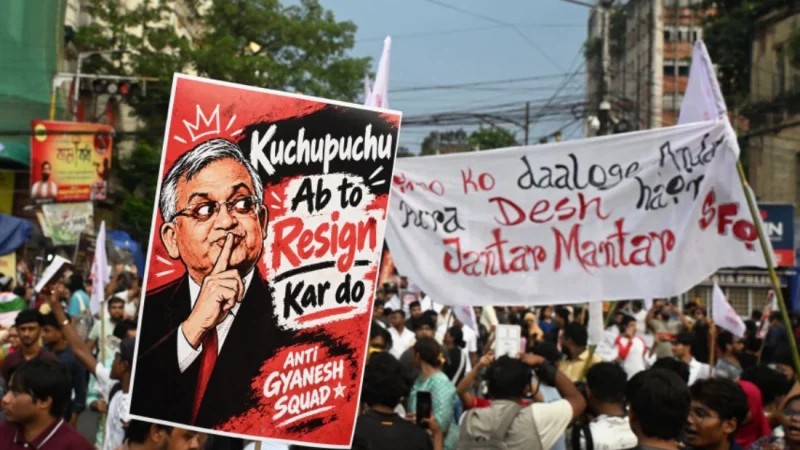
Youth movements are not a new phenomenon in South Asian politics, with young people frequently taking to the streets against corruption, demanding employment, and calling for democratic rights and government accountability. The debate surrounding Bangladesh’s July 2024 uprising and the movement led by the Cockroach Janata Party (CJP) in Delhi in October 2026 forms part of this broader political reality. Neha Bora, a prominent face of India’s youth movement, has stated that India’s Gen Z has drawn inspiration from Bangladesh’s uprising. However, questions remain over whether drawing inspiration from a movement is the same as equating the political realities of two countries, whether Bangladesh’s July experience accurately reflects India’s current political situation, and whether this comparison overlooks India’s democratic framework, constitutional institutions, and long political history.
Bangladesh’s July uprising emerged from years of political discontent, violent confrontations, loss of life, and a profound conflict between citizens and state power. India, by contrast, has multiple channels through which political dissatisfaction can be expressed within its electoral system, opposition politics, judiciary, and constitutional framework.
Although young people in both countries are raising questions, the contexts and consequences are not the same. Therefore, while learning from Bangladesh’s experience, it is equally important to assess India’s own democratic strengths and possibilities. This raises questions of whether India’s protests can be measured against Bangladesh’s experience of bloodshed using the same yardstick, whether Indian democracy still possesses the institutional capacity to address political crises, and whether movement leaders such as Neha Bora should explain these differences more responsibly.
Bangladesh’s July movement initially began with demands for the reform of the government job quota system. However, the situation rapidly transformed into a broader political uprising due to violence against protesters, widespread loss of life, and the state’s response. On August 5, 2024, the government of Sheikh Hasina fell. This transformation was driven by the sacrifices of countless individuals, the prolonged suffering of the injured, and the irreparable loss experienced by bereaved families.
According to an investigative report published in 2025 by the Office of the United Nations High Commissioner for Human Rights, as many as approximately 1,400 people may have been killed during the violence of July and August 2024. While this figure serves as an estimate rather than a definitive, individually verified list of fatalities, it conveys the devastating scale of the violence.
By contrast, reports concerning the CJP movement in Delhi, India, have referred to approximately 5,000 people being detained. According to the account provided, these individuals were released in the evening and no cases were filed against them. However, without independently verifying the full details, it would be inappropriate to draw definitive conclusions regarding the experiences of every person who was detained.
The fundamental distinction is that detention and loss of life are not equivalent experiences, nor are confronting a protest-related clash and suffering widespread, lethal repression the same thing. Bangladesh’s sacrifices cannot be reduced to a simple story of political success.
Neha Bora and other young leaders in India have every right to draw inspiration from Bangladesh’s movement. However, that inspiration should not obscure the human cost of the country’s history.
Bangladesh’s experience can enrich the language and aspirations of youth activism in India, but understanding the differences between the two countries is equally important. Does merely invoking Bangladesh’s name in a political speech demonstrate a genuine understanding of the sacrifices made by its people?
When comparing the political realities of India and Bangladesh, the institutional framework is considered one of the most important factors. Although Indian democracy is far from perfect, citizens possess every right to question the conduct of the Election Commission, the administration, the police, and other institutions, as no institution should be placed beyond criticism in a democracy. Instead, public scrutiny, legal challenges, investigative journalism, and electoral competition serve as essential mechanisms to ensure institutional accountability.
India’s political history offers important examples. In the 1970s, the student movement led by Jayaprakash Narayan developed into a broader protest against corruption, rising prices, and administrative failures. Subsequently, the declaration of Emergency in 1975 curtailed civil liberties, imposed press censorship, and led to the detention of opposition leaders. Yet the Congress Party’s defeat in the 1977 election demonstrated that electoral politics could serve as a significant mechanism for changing those in power.
The lessons of this history are twofold. First, allowing democratic institutions to weaken is dangerous. Second, when opportunities exist to protect civil liberties, express political opposition, and participate in electoral competition, citizens have multiple avenues for voicing their dissatisfaction.
The current movement in Delhi should be examined seriously, particularly regarding allegations concerning the neutrality of the Election Commission, voter-list revisions, and political accountability. However, the existence of allegations does not automatically establish that institutions have completely collapsed, just as the mere presence of institutions does not mean that every decision they make is correct.
One of the potential strengths of Indian democracy lies in the opportunities available to citizens to question institutional performance, approach the courts, generate public debate through the media, and challenge political decisions through elections. However, the effectiveness of these mechanisms depends on how they function in practice.
While Bangladesh’s experience can serve as a warning for Indian protesters, the possibilities offered by India’s own constitutional system should not be overlooked.
Before the July uprising, many of Bangladesh’s institutions had been seriously weakened. India has not experienced an identical institutional breakdown. Recognising this distinction is essential to understanding the different political circumstances of the two countries.
Bangladesh’s July uprising and Nepal’s Gen Z movement in 2025 have established new examples of youth mobilisation in South Asian politics. Through the combined use of social media, educational institutions, and street protests, young people can rapidly mobilise public opinion. However, assuming that a movement will produce the same political outcome in another country simply because it contributed to a change of government elsewhere is an oversimplification of political reality.
India’s vast and diverse political system features governments led by various political forces across its states, alongside multiparty competition, regular elections, and an extensive civil society that create a complex environment. The country’s democratic experience has been shaped by a diversity of languages, communities, and political perspectives. Additionally, its constitutional framework offers several potential avenues for expressing political dissatisfaction and challenging those in power.
Consequently, it would be inaccurate to claim that India’s governmental institutions have already collapsed. At the same time, preserving their strength requires continued efforts to ensure the neutrality of the Election Commission, the independence of the judiciary, freedom of the press, and police accountability.
Dismissing opposition protests as mere political theatrics is no more appropriate than portraying every protest as an inevitable prelude to a popular uprising.
This is where Neha Bora’s statement becomes significant. If Bangladesh’s movement has inspired young Indians, it represents a meaningful exchange of political experiences across South Asia. However, genuine political learning requires acknowledging the sacrifices made by Bangladeshis, the devastating scale of the violence, and the complex consequences of the uprising.
It also requires an informed assessment of India’s own democratic history and constitutional institutions.
Ultimately, the strength of democracy lies not only in changing governments but also in holding governments accountable, protecting citizens’ rights, and ensuring opportunities for the peaceful expression of disagreement. Bangladesh’s July uprising can remain an important chapter in the political consciousness of India’s youth, but India’s political future will be shaped by its own citizens, institutions, and political processes.
By honouring Bangladesh’s sacrifices while making constructive use of India’s democratic possibilities, can South Asia’s young people help build a political culture in which citizens’ rights matter more than the ambitions of those in power?
Why it matters
Bangladesh's July 2024 uprising continues to influence political movements across South Asia, highlighting the importance of understanding distinct democratic contexts when comparing youth activism.