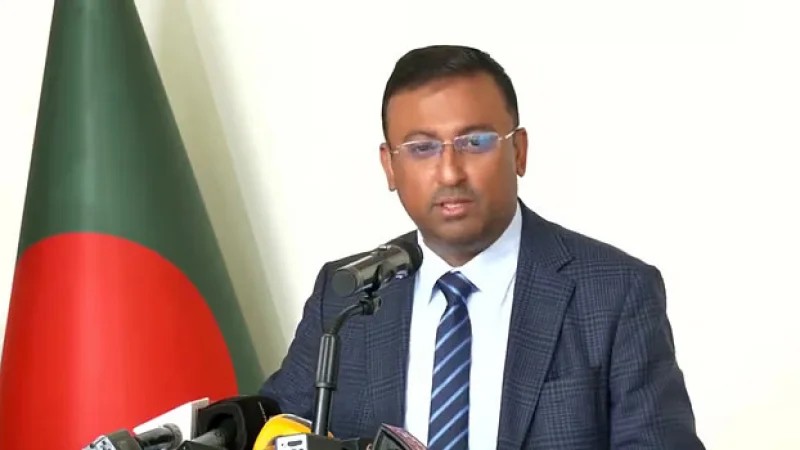
State Minister for Foreign Affairs Humaiun Kobir said on Saturday that Bangladesh is giving positive consideration to the Makkah Defence Agreement, adding that any decision will be guided by national interests and the potential contribution of the country’s peace‑keeping expertise to regional peace and stability.
Speaking at a national seminar at the Foreign Service Academy in the capital, he said, “We are having positive discussions on the Makkah Defence Agreement. We are viewing it positively.”
Kobir said Bangladesh could give a favourable decision if the agreement aligns with its national interests and if its peacekeeping expertise can contribute to the welfare of Muslim nations while helping to maintain peace and stability in the Middle East.
He said that if the proposal aligns with Bangladesh’s national interests and converges, and if Bangladesh’s peacekeeping expertise can add value in serving Muslim nations and preserving a stable, peaceful Middle East, then there is every scope to reach a positive decision on the matter.
The Bangladesh Institute of International and Strategic Studies (BIISS) and the Center for Migration Studies at North South University (NSU) jointly organized a seminar titled “From Workforce to Strategic Partnership: Reimagining Bangladesh‑KSA Relations.”
The state minister said that Prime Minister Tarique Rahman has accepted an invitation from Saudi Arabia’s Crown Prince to visit the Kingdom.
Kobir said the individual had accepted and would act on it in the near future, stating, “He has accepted and will do so at some point very soon.”
The official said the Crown Prince has expressed interest in visiting Bangladesh and noted that Dhaka would welcome him at a mutually convenient time. He added that the invitation remains open pending suitable scheduling.
Kobir said the planned visits demonstrate the deepening political relationship between the two nations. He added that Bangladesh is a strong partner of Saudi Arabia in maritime security.
He urged the establishment of a comprehensive economic and strategic partnership, stating that bilateral relations ought to move beyond their traditional emphasis on labour migration and remittances.
“While that foundation remains important, it cannot be the ceiling of our ambition,” he said.
He said that Saudi Arabia’s Vision 2030 and Bangladesh’s economic transformation have generated shared interests in investment, human capital, technology and connectivity.
He said that talks were ongoing about establishing an investment fund to enable joint investments and partnerships in priority sectors.
The state minister said that renewable energy, infrastructure, ports and logistics are among the sectors seen as promising for Saudi investment. He also highlighted agriculture, fisheries, food security, healthcare, pharmaceuticals, information technology and artificial intelligence as further areas of interest.
He said such investments required a predictable and transparent business environment, improved institutional coordination and timely decision-making.
Kobir emphasized that Saudi Arabia must transition to a workforce of trained and certified professionals in order to meet the evolving demands of its labour market.
He urged greater collaboration among training institutions, universities and industry to ensure that skills certification aligns with the requirements of the Saudi market.
He stated that the welfare, dignity and rights of Bangladeshi workers in Saudi Arabia would continue to be a government priority.
Kobir underscored the prospects for knowledge and technology partnerships, as well as collaboration in ports, shipping, logistics, aviation and supply chains.
“The next chapter of Bangladesh‑Saudi Arabia relations should therefore be defined by value creation rather than volume alone,” he said.
Saudi Arabia’s ambassador to Bangladesh, Dr Abdullah Zafer bin Abiyah, addressed the seminar as the guest of honour. The event also featured remarks from Dr Md Nazrul Islam, Secretary (Bilateral) of the Foreign Ministry, and Md Mokhtar Ahmed, Secretary of Expatriates’ Welfare and Overseas Employment, who spoke as special guests.
The seminar also featured remarks from Major General A S M Ridwanur Rahman, Director General of the Bangladesh Institute of International and Strategic Studies (BIISS), and Professor Abdul Hannan Chowdhury, Vice‑Chancellor of North South University.
Kobir told reporters after the event that peace and stability in the Middle East and the Muslim world were central to Bangladesh’s consideration of the Makkah Defence Agreement.
He said that maintaining peace in the region encompassing Makkah and Madinah was a key objective, and added that Bangladesh could deploy its peacekeeping expertise more effectively and extensively across the world.
He said that proposals concerning participation in the agreement or affiliation with the alliance were being viewed favorably, while emphasizing that regional peace and stability remain the top priority.
Kobir said that regular high‑level exchanges, encompassing ministerial and other official visits in both directions, are strengthening bilateral engagement.
He emphasized the importance of broadening employment prospects into energy, technology and other emerging sectors, and of dispatching additional highly‑skilled professionals to Saudi Arabia.
He said that positive talks are underway with Saudi Arabia and, God willing, many new opportunities will arise between the two nations.
The state minister said there is scope for a broad investment partnership that would enable Bangladesh and Saudi Arabia to jointly invest in profitable sectors.
He told journalists, “The days of dependency are over. We are now placing emphasis on an equal partnership between the two countries and on sustainable policies.”
Why it matters
The positive consideration of the Makkah Defence Agreement signals a deeper strategic and security alignment between Bangladesh and Saudi Arabia.