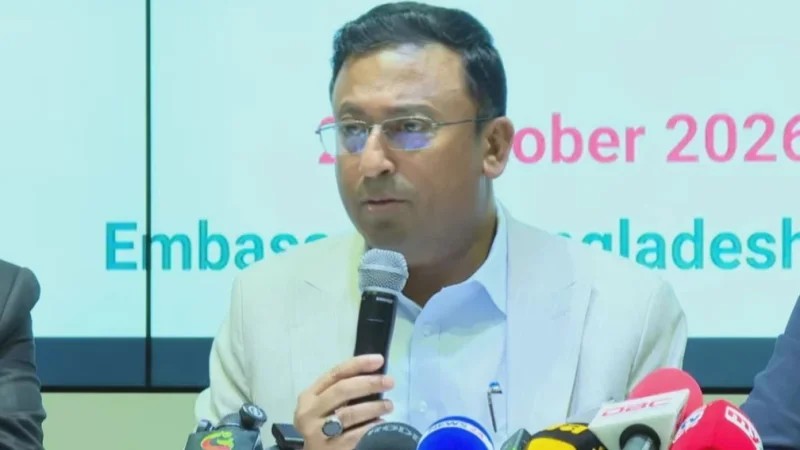
Prime Minister Tarique Rahman has emphasized Bangladesh’s national interests in strengthening ties with Japan, prioritizing development projects and investment that can create jobs, State Minister for Foreign Affairs Humaiun Kobir said on Tuesday.
Briefing reporters at the Bangladesh Embassy in Tokyo following the prime minister’s bilateral summit with Japanese Prime Minister Sanae Takaichi, Kobir stated that the discussions centered on enhancing trade, investment, and economic cooperation, as well as advancing strategic projects.
He said that Japan’s private sector plans to invest approximately $6.34 billion in Bangladesh over the next five years, which could potentially create employment opportunities for about 200,000 people.
The state minister stated that Tarique emphasized the necessity of prioritizing investments in industries capable of creating jobs. This comes as the government aims to convert rising international interest in Bangladesh into tangible investment.
He said the two countries also discussed expediting the implementation of the Bangladesh-Japan Economic Partnership Agreement (EPA), which was signed in February 2026.
Kobir stated that the prime minister sought Japan’s support to ensure a smooth and sustainable graduation of Bangladesh from the least developed country (LDC) category.
Bangladesh requested an additional three years to prepare for its graduation from Least Developed Country (LDC) status, citing the impacts of the COVID-19 pandemic, long-standing economic challenges, and the recent global energy crisis, he said.
The state minister said Bangladesh urged Japan to give serious consideration to the request.
He said the two sides also discussed establishing a ministerial-level joint mechanism to accelerate bilateral cooperation, identify priority sectors, set specific timelines, and regularly review progress.
Kobir stated that Japan has expressed interest in projects concerning investment in Bangladesh’s energy sector, the development of infrastructure—including elevated expressways—and the creation of a technology-based industrial city.
He also referred to Japanese development assistance worth 50 billion yen, equivalent to around $340 million.
Describing the visit as important for creating new investment opportunities and strengthening economic ties, the state minister said international partners are showing renewed interest in Bangladesh following the formation of its new democratically elected government.
He said one of the main objectives of the visit is to translate that interest into actual investment.
The prime minister’s visits to Japanese energy infrastructure and logistics facilities also provided opportunities to learn from Japan’s expertise, particularly regarding liquefied natural gas terminal development and modern logistics management, Kobir added.
Replying to a question regarding employment opportunities for Bangladeshi students and workers in Japan, he stated that the two nations are discussing Japanese-language training and the development of skilled manpower, noting that a process is already at the implementation stage.
Regarding the Rohingya crisis, the state minister stated that Bangladesh plans to raise the issue prominently in multilateral diplomatic forums next year, adding that the country hopes for a positive role from Japan.
Describing the prime minister’s visit as fruitful, he stated that the constructive discussions between the two leaders opened up new possibilities for Bangladesh’s development, industrialisation and job creation.
Prime Minister’s Additional Press Secretary Atikur Rahman Rumon and Deputy Press Secretary Shahadat Hossain Shadhin were also present at the briefing.
Why it matters
The briefing outlines key economic agreements and multi-billion-dollar private investment plans stemming from Prime Minister Tarique Rahman's state visit to Japan.