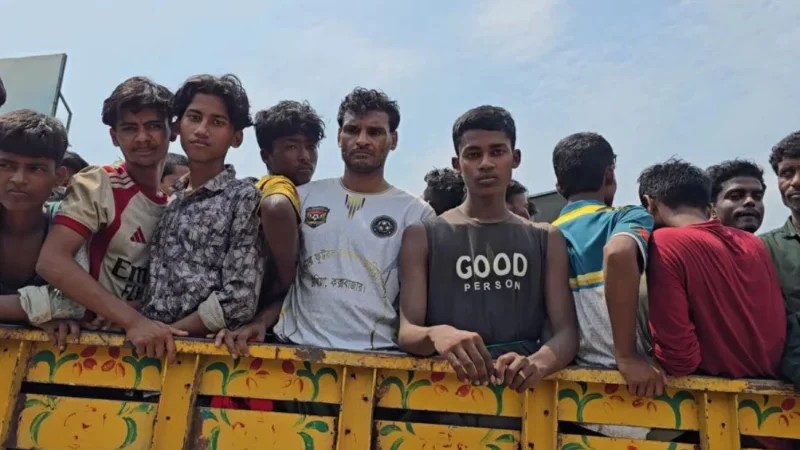
Enamul Haque Kayes, a physically disabled man from Teknaf who served as the sole breadwinner for his family, worked at a Bonoful shop in Hnila until he went missing approximately 10 days ago. Following a fruitless search by his relatives, the family discovered that he was among 76 individuals rescued by the Bangladesh Navy near Saint Martin’s Island.
His family alleges that Kayes was abducted and sold to traffickers who attempted to smuggle him to Malaysia by sea.
His case highlights growing concerns along the Teknaf coast, where trafficking networks are reportedly using abduction, confinement, and ransom demands to force victims into dangerous sea journeys.
As calmer seas create favourable conditions for maritime crossings, trafficking networks have become active again. Over the past week, law enforcement agencies have rescued more than 150 people, including Rohingya refugees, and arrested at least 15 suspected brokers.
Kayes’s father, Ahmudul Rahman, said his son was the family’s sole breadwinner.
“My son has a disability, but he was the only person supporting our family financially. We searched everywhere but could not find him. Later, I learnt that he was among those rescued by the Navy,” he said.
Ayat Ullah, a ninth-grade student at Teknaf Government Technical School and College, was among those rescued. He stated that his abductors took him to a hill close to the Mochoni Rohingya camp, where he was held captive alongside other individuals.
His captors initially sold him to a broker for Tk30,000, he said. The broker then sold him to another person for Tk1 lakh.
After nearly a month in captivity, Ayat and the others were taken to Kachhapia in Baharchhara and put aboard a trawler off Marine Drive.
“After three days at sea, the boat broke down and water began entering it. We thought we might never make it back alive. Later, the Navy rescued us,” he said.
In a separate incident, armed men abducted Mostak Ahmed at gunpoint from Hnila union and demanded a ransom of Tk10 lakh from his family. Ahmed was released three days later after his family negotiated and paid Tk5 lakh.
Mohammad Saber, a 32-year-old resident of Kochubania in Sabrang union, stated that his abductors detained and tortured him for three days to coerce his family into paying a ransom. He was subsequently trafficked to Malaysia through Myanmar and Thailand.
Saber returned to Bangladesh on October 9, 2024, following nearly four years abroad. Injuries sustained during his captivity resulted in lasting damage to his head and eyes, preventing him from working normally.
In recent operations, police rescued 16 people, including Rohingya refugees, from Kachhapia. Border Guard Bangladesh and police also dismantled 20 suspected trafficking hideouts in the hills of Rajarchhara, rescuing 16 people reportedly abducted for trafficking and arresting a suspected broker. Additionally, the SRB separately rescued five people from Kachhapia.
A M Faruk, assistant director of law and media for SRB-15, stated that operations were underway to identify and arrest those involved in human trafficking. He also called for greater public awareness and cooperation to help combat the issue.
Between 2016 and 2025, a total of 3,534 people traveling toward Malaysia were rescued off the Cox’s Bazar coast, with the majority being Rohingya refugees.
During the same period, a total of 120 cases were filed with Ukhiya and Teknaf police stations in connection with these incidents.
Meanwhile, 330 people were reportedly abducted in Teknaf over the past three years. Locals alleged that victims unable to pay ransom were often sold to trafficking networks.
The dangers extend far beyond captivity. In a joint statement, the UN refugee agency and the International Organization for Migration said more than 500 people were feared dead after two boats carrying Rohingya refugees sank off Myanmar’s Rakhine State in June. The agencies also reported that around 300 Rohingya refugees and Bangladeshis had died or gone missing this year while attempting dangerous sea journeys.
Belal Mia, a farmer from Teknaf Sadar, was among those missing after a trawler sank in the Andaman Sea. His pregnant wife, Ayesha Begum, said brokers had forcibly put her husband aboard a boat. She has received no news of him for nearly three months.
According to district police and the Bangladesh National Women Lawyers’ Association, more than 600 human trafficking cases were filed in Cox’s Bazar between 2012 and 2026. Around 480 cases remain pending, including more than 300 in Ukhiya and Teknaf.
Biswajit Bhowmik, a lawyer with the association, said Cox’s Bazar lacked a dedicated tribunal for human-trafficking and migrant-smuggling cases, contributing to lengthy trials.
Shariful Islam Hasan, associate director of BRAC’s migration programme, said traffickers were increasingly resorting to abduction alongside deception and false promises of marriage or employment.
Cox’s Bazar Additional Superintendent of Police Md Ahidur Rahman said abduction and trafficking were closely linked, with some victims being trafficked when their captors failed to obtain ransom payments. He said law enforcement agencies were continuing raids and intelligence operations to bring those responsible to justice.
Why it matters
The surge in abductions and maritime trafficking along the Teknaf coast underscores the growing security challenge for Bangladesh's law enforcement and the vulnerability of Rohingya refugees and coastal communities.