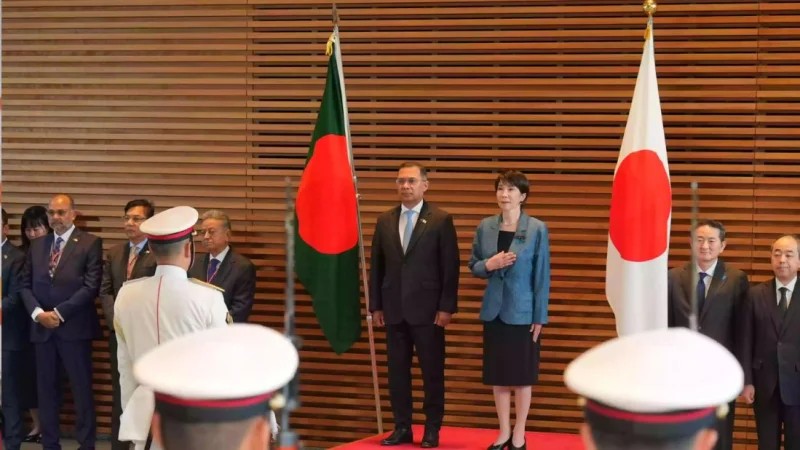
In light of the rapidly changing global situation, increasingly prevalent supply chain risks, rapid technological innovation, and mounting social issues, Bangladesh and Japan are upgrading the BIG-B initiative to “BIG-B for Shared Prosperity.” The move is part of a strategic cooperation effort within the exclusive partnership between the two nations.
This is aimed at enhancing the resilience and preserving each country’s freedom of decision, said the Japanese government.
Meanwhile, Bangladesh and Japan signed a number of Memoranda of Cooperation and other documents between the two countries, the Japanese side said.
The two countries signed five cooperation documents covering economic relations and the business environment, agriculture, fisheries and livestock, and environmental protection.
These include a memorandum of cooperation between Japan’s Ministry of Economy, Trade and Industry and Bangladesh’s Economic Relations Division; separate memoranda between Japan’s Ministry of Agriculture, Forestry and Fisheries and Bangladesh’s Ministry of Agriculture and Ministry of Fisheries and Livestock; a memorandum of cooperation on the environment between Japan’s Ministry of the Environment and Bangladesh’s Ministry of Environment, Forest and Climate Change; and a letter of intent between Japan’s Global Environment Bureau and Bangladesh’s Department of Environment under the Ministry of Environment, Forest and Climate Change.
BIG-B, which stands for the Bay of Bengal Industrial Growth Belt, is an economic development initiative centered around three pillars: the development of economic infrastructure, the improvement of the investment environment, and the strengthening of connectivity.
It has served as the flagship initiative of Japan-Bangladesh cooperation and has long supported Bangladesh’s economic growth.
According to the Japanese Ministry of Foreign Affairs, the "BIG-B for Shared Prosperity" initiative positions Bangladesh as a hub designed to promote common prosperity and contribute to mutual growth.
Japan and Bangladesh have agreed to strengthen cooperation in connectivity, energy security, disaster resilience, trade, investment and defence to promote economic growth and regional peace and stability.
Under the proposed cooperation framework, the two countries will promote integrated economic infrastructure development centred on the Matarbari Deep-Sea Port. This initiative encompasses power and energy facilities, airports, roads, railways, inland waterways, and special economic zones, aiming to strengthen supply chains and develop Bangladesh into a logistics and industrial hub.
They will also work to improve the investment climate, develop human resources, expand public-private partnerships, and establish transparent and predictable rules designed to attract investment.
Both sides will seek to expand trade and investment under the Japan-Bangladesh Economic Partnership Agreement (EPA), improve market access, and promote industrial upgrading and export diversification.
The cooperation will also focus on building resilient supply chains across sectors including manufacturing, logistics, food and agriculture, information and communication technology, and pharmaceuticals.
To enhance energy security, the two nations will advance initiatives through Japan’s “POWERR Asia” framework to ensure a stable and economically viable energy supply. Additionally, they will explore opportunities for energy infrastructure development within the Matarbari region.
They will also enhance cooperation to address natural disasters and climate change, including strengthening emergency response capabilities and developing sustainable disaster-prevention infrastructure.
In the security sector, Japan will support Bangladesh's capacity-building efforts and promote bilateral security and defense cooperation, with a focus on maritime security, maritime domain awareness, coastal patrols, and port security.
The framework includes providing patrol boats to Bangladesh under Japan's first Official Security Assistance (OSA) project, exploring a second OSA project, and supplying patrol vessels through official development assistance (ODA) to strengthen coastal security capabilities.
Both countries will also work to improve their ability to respond to emerging technological challenges, including cybersecurity, as part of broader efforts to enhance resilience against geopolitical uncertainties and promote peace and stability.
Japanese Prime Minister Sanae Takaichi and Bangladesh Prime Minister Tarique Rahman on Tuesday reaffirmed their commitment to further strengthen bilateral relations under the two countries’ Strategic Partnership, with a focus on regional peace, prosperity and stability.
During a summit meeting in Japan, Takaichi offered congratulations to Tarique Rahman on assuming office as prime minister. Takaichi also described Bangladesh as a friend that shares the values of democracy.
Amid growing international instability, she stated that Japan strongly supports Bangladesh’s ability to make its own decisions freely and strengthen its resilience under Japan’s updated “Free and Open Indo-Pacific” (FOIP) vision.
Takaichi also expressed her intention to work with Tarique Rahman to promote peace and prosperity in the region.
In response, Tarique Rahman stated that Japan, as a peace-loving nation, was among the first countries to recognize Bangladesh’s independence and holds a special place in the hearts of the Bangladeshi people.
He stated that the two nations had established longstanding friendly relations and expressed his commitment to working with Takaichi to elevate bilateral ties to new heights.
The two leaders held the summit meeting on October 27 from 11:45 am for approximately 25 minutes, followed by a joint press event and luncheon, according to the Japanese Ministry of Foreign Affairs.
Why it matters
The upgrading of the BIG-B framework deepens bilateral economic, infrastructure, and security cooperation between Bangladesh and Japan.