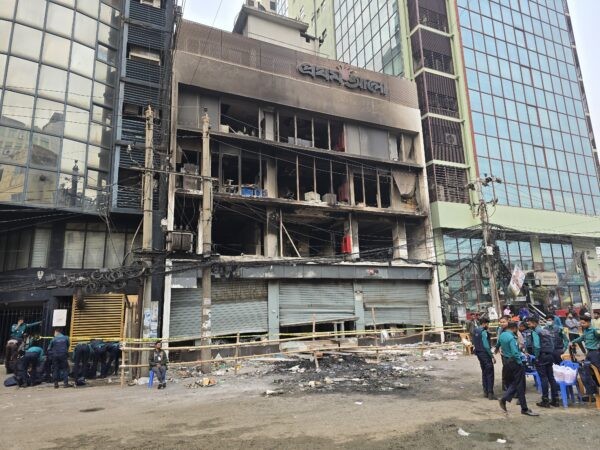
Since the Sheikh Hasina administration was ousted on 5 August 2024, mob violence in Bangladesh has escalated to serious proportions.
The incidents span a spectrum, from individuals being beaten to death after accusations of religious blasphemy. Other attacks have been driven by personal vendettas or attempts to seize property.
Mobs have engaged in vandalism, attacking shrines, newspaper offices, cultural organisations, national monuments and memorials associated with the 1971 liberation war. They have also exhumed bodies from graves.
The recent killing of 38‑year‑old Wahiduzzaman Shamim in Satkhira, in southwestern Bangladesh, on accusations of blasphemy and alleged attacks on a charitable maternity clinic in the capital, Dhaka, has further heightened these concerns.
After the exit of the Awami League government, the interim administration under Dr.
Mohammad Yunus, whose term ran from August 2024 to February 2026, failed to act effectively as the law‑and‑order situation deteriorated.
Since February, Bangladesh has an elected government led by the Bangladesh Nationalist Party (BNP).
Data from the Human Rights Culture Foundation indicate that 537 incidents of mob violence were recorded in Bangladesh between 1 January and 17 October 2026, resulting in 256 deaths and 575 injuries. The foundation noted that the same type of incidents numbered 428 in 2025 and 169 in 2024.
According to data released by the rights organization Ain o Salish Kendra (ASK), 171 people were killed in mob violence between 1 January and 30 September of this year. The organization recorded 128 deaths in 2024 and 198 in 2025.
Although data‑collection and calculation methods differ among organisations, the figures indicate the same picture: mob violence has escalated into a serious public‑security crisis in Bangladesh.
Allegations have emerged that leaders and activists of the ruling Bangladesh Nationalist Party are implicated in incidents concerning the seizure of property.
The most notable BNP‑related incident in the past eight months was the assault on a 50‑year‑old government‑run maternity centre in Dhaka, the only medical facility serving women from the city’s slums.
According to authorities, a group of local shopkeepers allegedly carried out the attack in order to seize the hospital’s land.
The BNP has expelled several local leaders in this incident and forced a parliamentarian to resign.
Questions have been raised about the involvement of the opposition Jamaat‑e‑Islami, Bangladesh’s largest Islamist party, and its affiliates in mob violence linked to religious issues.
The killing of 38‑year‑old Shamim, carried out in the name of protecting Islam, is cited as one such example.
Shamim, who suffered from a mental illness, was beaten to death by a mob.
The violence was triggered by audio clips that allegedly contained derogatory remarks about Islam.
Police initially rescued Shamir and admitted him to a local hospital. However, that same night a frenzied mob of roughly 250 people attacked the hospital.
The family members of the deceased have alleged that members of the Jamaat were involved in the incident.
Jamaat‑e‑Islami has denied the allegations, asserting that it is a political organization that upholds the rule of law, justice and democratic values.
Determining the veracity of allegations requires impartial investigations and concrete evidence.
Treating unproven allegations as established facts is as unjust as shielding individuals from investigation solely on the basis of their political affiliation.
Accordingly, when allegations are made, the police are required to register the complaints, and the courts are responsible for trying the accused under the law.
But this isn’t happening in Bangladesh today.
The leaders of Bangladesh’s ruling Bangladesh Nationalist Party (BNP) and the opposition Jamaat‑e‑Islami repeatedly accuse each other of being responsible for incidents of mob violence.
Neither party is committed to putting an end to such mob actions.
In Bangladesh, the majority of mob‑violence incidents recorded over the past two years have been carried out in the name of the Tawhidi Janata, a term that translates as “the devout masses.”
Before the Satkhira incident, a Jamaat activist and the leader of its student wing in Kushtia were reported to have attacked a shrine, exhumed the body of a deceased pir (spiritual leader) from his grave and set it on fire.
Activists linked to Bangladesh Jamaat‑e‑Islami have also been accused of carrying out comparable actions at a prominent shrine in Dhaka.
Yet, the Jamaat has not expelled any of them.
They simply dismissed allegations of the party’s involvement.
When members of a political party are subject to such allegations, the party cannot simply evade responsibility; it must cooperate with independent investigations and take appropriate organisational action against those accused.
This responsibility applies equally to all political parties, regardless of whether they are currently in power or serving in the opposition.
The BNP government has repeatedly claimed that it is dealing firmly with mob violence.
Home Minister Salahuddin Ahmed said that since the BNP took office, mob violence has declined.
Regarding allegations of political involvement, he said that these must be verified through investigation.
Regardless of whether violent incidents have declined, the more pressing issue is whether law‑enforcement agencies respond promptly when an individual is beaten on the streets or when a mob vandalises an institution.
Should authorities fail to arrest the perpetrators, conduct an impartial investigation and prosecute them under the law, their warnings will be perceived as empty rhetoric.
It is important that justice is done on the basis of the crime committed, and not the identity of the person committing the crime.
Bangladesh police are still not fully operational since the July-August 2024 protests.
According to an OHCHR fact‑finding report, 450 of the 639 police stations across Bangladesh were destroyed or damaged during the protests and the subsequent retaliatory attacks. The report documents extensive damage to the country’s law‑enforcement infrastructure.
Hundreds of police personnel were forced into retirement.
Many police officials say they hesitate to make decisions that could later become politically controversial.
Officials stress that mob violence cannot be addressed unless political parties allow the police to carry out their duties and politicians restrain their supporters.
Why it matters
The persistence of mob violence highlights critical weaknesses in law enforcement and institutional accountability within Bangladesh.