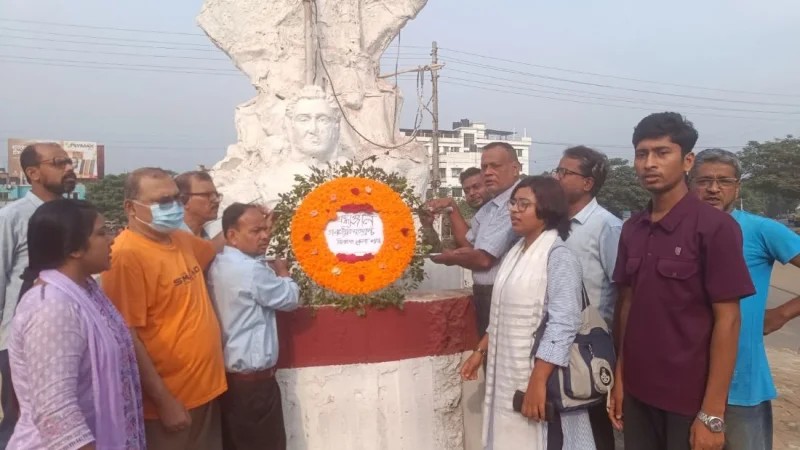
Leaders of several left-leaning political parties and progressive organisations, along with representatives of the district administration and freedom fighters, paid tribute to Bir Sreshtha Hamidur Rahman in Jhenaidah on his 55th death anniversary on Wednesday.
The Democratic United Front organised a procession and rally at the sculpture of the Liberation War hero near the town’s bus terminal early in the morning, followed by the placing of floral wreaths.
Those present included CPB Jhenaidah district general secretary Abu Tawab Opu, Bangladesh Socialist Party district convener Advocate Asadul Islam, Revolutionary Communist League district general secretary Shahidul Enam Pallab, National People’s Front district coordinator Nehal Ahmed Sohel and Hamidur Rahman’s nephew Hafizur Rahman.
At the rally, the leaders expressed frustration over the failure to repair and restore Hamidur Rahman Square and its sculpture properly, as well as the lack of adequate security measures at the site.
They also criticised the authorities for failing to take exemplary legal action over previous incidents of attacks and disrespectful acts involving the sculpture, including the placing of a garland made of shoes.
The speakers alleged that groups opposed to the Liberation War were carrying out attacks across the country and disrupting democratic political and cultural programmes through mob actions. They said such activities amounted to an assault on the legacy of the 1971 Liberation War.
The leaders also condemned a reported attack on the Communist Party of Bangladesh’s central office over the use of the slogan 'Joy Bangla', describing the incident as a failure of the government to protect democratic political activities.
They expressed concern over reports that the burial of freedom fighter Manik Pashari had been obstructed in Pirojpur and called for those responsible to be arrested.
Calling on the government to take effective action against forces opposed to the country’s independence, the speakers urged it to uphold the ideals of the Liberation War.
They further alleged that the government’s indecisive response to such incidents was allowing anti-Liberation War forces to gain ground and pushing the country towards a political outlook resembling that of Pakistan.
Why it matters
The event highlights growing security concerns and political friction regarding the protection of national heritage and democratic activities in Bangladesh.